XGram
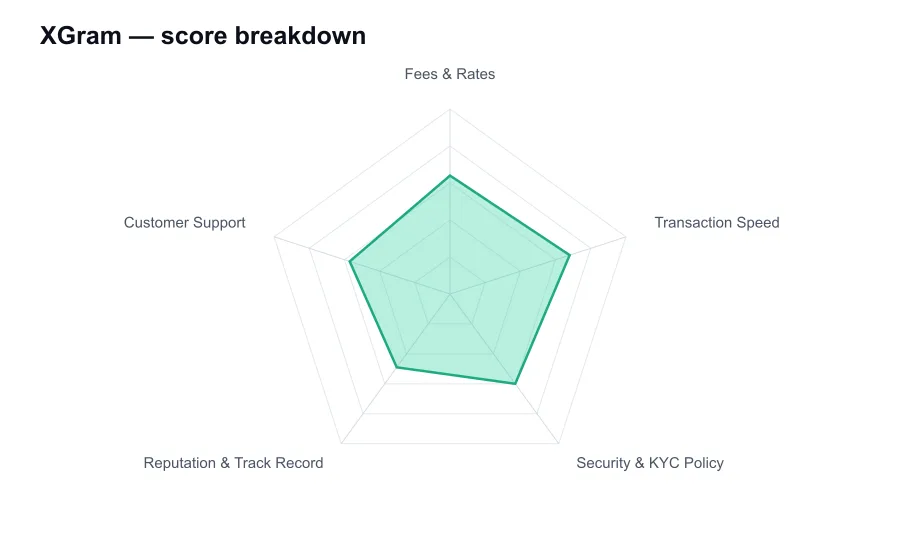
XGram scores 6.0/10 overall in our independent review, measured against every other provider we've compared, strongest on Transaction Speed (6.8/10) and weakest on Reputation & Track Record (4.9/10).
| Best for | Simple wallet-to-wallet swap process, No standing custodial trading balance, Fixed-rate routes may be available, Useful for small, direct conversions |
|---|---|
| Not for | Limited public track record versus established rivals, Pricing is mainly embedded in the quote, Compliance reviews can interrupt a no-account swap, Not suitable for large or urgent transfers |
What is XGram?
How XGram Works
- Select the cryptocurrency and network to send
- Choose the cryptocurrency and network to receive
- Enter a destination address that supports the chosen network
- Review the displayed quote and rate type
- Send the required deposit to the generated address
- Follow the order status until the payout is sent
KYC
| Requirement | optional |
|---|---|
| Notes | The normal swap flow may not require routine account verification, but XGram can request KYC or additional information if compliance screening flags a transaction. |
Supported Assets
| Notable | Bitcoin, Ethereum, Tether, USD Coin, Litecoin, Solana, BNB |
|---|
How to Use XGram Safely
- Test a new asset and network route with a small amount
- Compare the quoted payout with at least two alternatives
- Confirm the stablecoin network before sending
- Use a fixed quote only if you can meet its deposit deadline
- Save every order detail and blockchain transaction hash
- Do not send a large first-time transaction to a smaller provider
Full Review
XGram is a smaller instant crypto exchange service built for direct wallet-to-wallet conversions. Its pitch is familiar: select a pair, send a deposit, and receive a different asset without maintaining a trading account. The market is full of services making that promise, so XGram has to be judged less by the polish of its swap form and more by execution, transparency, and the strength of its public record.
The platform is designed for simplicity. A casual user does not need to understand an order book, maker fees, or margin settings to exchange coins. That is a legitimate advantage for someone who only needs to turn one asset into another. It is also why people can become careless. Simple interfaces make irreversible transfers feel safer than they are.
XGram is not a venue for active trading. There is no reason to use an instant exchanger for repeated BTC or ETH speculation if you already have access to a liquid exchange. The spread and execution uncertainty make that inefficient. XGram is better understood as a transaction service, useful when a person wants to convert funds from one wallet to another without opening an account and parking assets on a custodial platform.
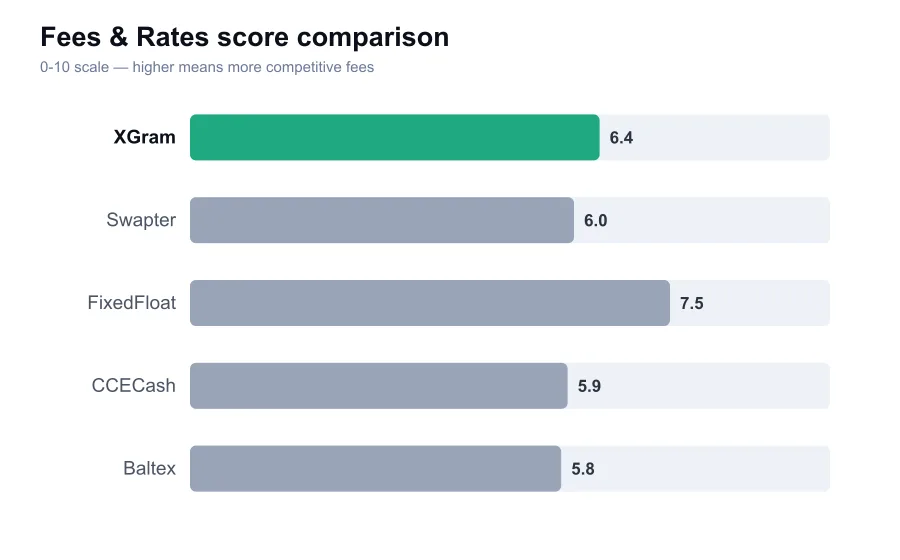
Fees are mostly reflected in the offered rate rather than presented as a clean trading commission. That is standard for this type of business, but it makes price comparison essential. A quote can look attractive while still carrying a wide spread, especially on low-volume tokens or expensive networks. Check the destination amount against at least two alternatives and do not focus only on a headline claim about low fees.
For a common pair with healthy liquidity, the all-in price can be acceptable. For obscure assets, it can deteriorate quickly. The practical issue is not whether XGram technically lists a token. It is whether the service can obtain and deliver it at a reasonable rate after your deposit has enough confirmations. Thin routes are where instant exchanges expose their weak spots.
XGram offers the usual choice between floating and fixed quotes where a route supports it. A fixed quote is the sensible selection if you need a known payout amount and can meet the deposit deadline. Floating rates can work well in quiet markets, but the customer takes more price risk while the deposit moves through the blockchain. Do not confuse a displayed estimate with a guaranteed settlement amount.
Transaction speed is dependent on chain conditions and the liquidity route. Transfers on fast, inexpensive networks may settle quickly after a confirmation. Bitcoin and Ethereum can take much longer, especially when fee conditions are poor or the service needs more confirmations before releasing a payout. A delay is not automatically evidence of misconduct, though poor status communication is a fair reason to be concerned.
The security model is noncustodial in the narrow, practical sense that XGram does not ask users to hold a standing trading balance in an account. That reduces exposure to a centralized exchange collapse. It does not mean the swap is trustless. You must transfer coins into the transaction flow, then rely on XGram and its liquidity arrangements to complete the other side. There is no blockchain undo button if you send the wrong asset or network.
KYC is another area where users should read the fine print rather than the headline. Small transactions may proceed without account verification, but compliance reviews can happen. A transaction connected to a risky source, an unusual amount, or a provider's screening rules can be paused. Anyone who cannot tolerate that possibility should not send funds to a service whose policy allows manual review.
XGram's biggest weakness is reputation depth. It is a smaller brand with a much lighter public record than established aggregators such as Trocador or long-running instant exchange names such as ChangeNOW. A smaller footprint does not prove bad conduct. It does mean there are fewer years of public incidents, support cases, and independent discussion to assess. That should affect the amount you are willing to risk.
Support channels matter more for XGram than the smooth homepage suggests. Most successful swaps never need help, but failures are high-stakes because the customer has already sent crypto. Good support should identify the deposit transaction, confirmation count, route status, and expected next action. Vague messages about technical issues are not enough, particularly if the service asks for additional information after taking custody of a deposit.
I would not use XGram as my first choice for a very large transfer. The sensible approach is to test the exact asset and network with a small amount, then assess the time, received amount, and support responsiveness. That is not paranoia. It is the correct procedure for any smaller instant exchange that does not have the balance sheet, disclosure, and long operational history of an established global venue.
Users should be especially strict with stablecoins. USDT and USDC exist across several chains, and sending an ERC-20 token to a Tron or BNB Smart Chain deposit address can create a recovery problem. Also verify whether the receiving wallet supports the token on that network. A completed swap is no help if the destination wallet cannot display or access the asset.
XGram can serve a narrow purpose well: a quick, low-to-medium value wallet conversion after careful quote checking. It has the convenience expected from an instant exchanger, but its limited reputation means the burden of caution stays with the customer. I would choose a better-known aggregator for complex or expensive swaps. Use XGram only after a test transaction has shown that the route behaves as advertised.
Criteria Scores
| Criterion | Score | Note |
|---|---|---|
| Fees & Rates | 6.4 | Rate-based pricing requires external quote checks |
| Transaction Speed | 6.8 | Normal instant-swap timing, chain dependent |
| Security & KYC Policy | 6.0 | No standing balance, but swaps remain counterparty risk |
| Reputation & Track Record | 4.9 | Smaller brand with a limited public track record |
| Customer Support | 5.7 | Web support, limited evidence of high-volume handling |
Key Facts
| Fact | Value | Source |
|---|---|---|
| Service type | Instant cryptocurrency exchange | — |
| Account model | Swap orders without trading balance | — |
| Rate options | Fixed or floating by route | — |
| Pricing model | Quote and spread based | — |
| Settlement | Onchain deposit and payout | — |
Pros & Cons
| Pros | Cons |
|---|---|
| Simple wallet-to-wallet swap process | — |
| No standing custodial trading balance | — |
| Fixed-rate routes may be available | — |
| Useful for small, direct conversions | — |
Does XGram hold a customer account balance?
XGram is built around individual swap orders rather than a conventional trading account with a standing portfolio balance. Funds are sent for a specific onchain conversion.
Can XGram request identity verification?
Yes. A swap can be subject to compliance review even if the normal flow does not require account registration. Do not assume that no signup means verification is impossible.
Should I use a fixed or floating XGram quote?
Choose a fixed route if you need a stated payout and can deposit inside the order window. A floating route can change with the market while confirmations are pending.
Why might an XGram swap take longer on Bitcoin?
Bitcoin deposits need blockchain confirmations before a swap can progress. Congestion, low network fees, and the route's confirmation policy can all increase the wait.
Can I send USDC or USDT on any network?
No. Check the exact network shown in the XGram order. Ethereum, Tron, Solana, and BNB Smart Chain versions of stablecoins are different transfer routes.
What should I save if an XGram order is delayed?
Keep the order ID, deposit address, sent amount, blockchain transaction hash, selected network, and screenshots of the quoted payout before contacting support.