CCECash
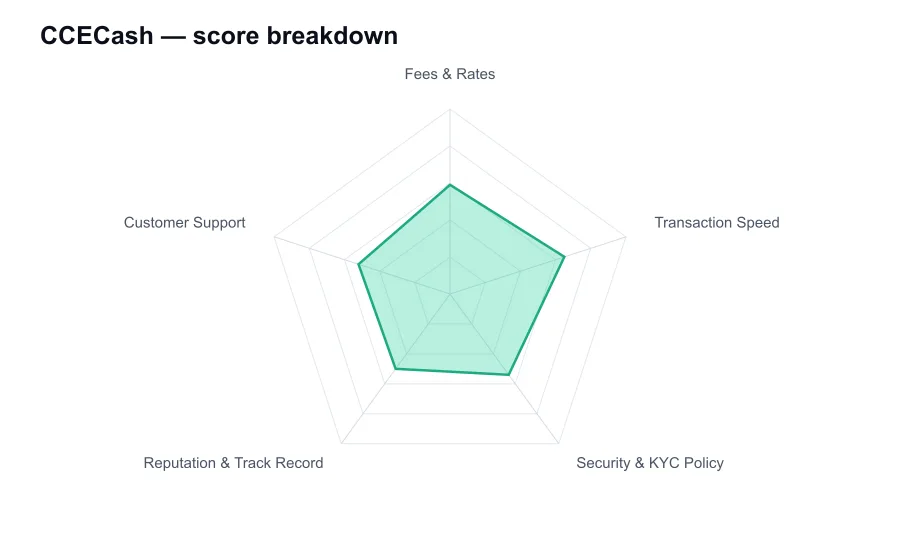
CCECash scores 5.6/10 overall in our independent review, measured against every other provider we've compared, strongest on Transaction Speed (6.5/10) and weakest on Reputation & Track Record (5.0/10).
| Best for | Fast quote-and-deposit setup, Useful for simple asset conversions, No order book required, Can fit small wallet-to-wallet swaps |
|---|---|
| Not for | Limited public transparency and track record, Effective fees require quote comparison, Not suitable for large or time-critical transfers, Potential AML reviews can interrupt settlement |
What is CCECash?
How CCECash Works
- Select the crypto pair and enter the exchange amount
- Provide a receiving wallet address on the correct network
- Review the live quote and create the order
- Send the required amount to the generated deposit address
- Track confirmations and wait for the output transaction
KYC
| Requirement | tiered |
|---|---|
| Notes | A conventional trading account is not central to the swap flow, but compliance screening may result in an identity or source-of-funds request. |
How to Use CCECash Safely
- Check the exact receive amount against another instant exchanger
- Confirm the asset network before sending any stablecoin
- Test a new route with a small transaction
- Keep the order ID and blockchain transaction hash
- Do not use an instant exchange as a long-term wallet
Full Review
CCECash is a compact instant crypto exchange service, not a full-scale trading venue. It targets the familiar user who has one coin, wants another, and would rather avoid account creation, order books and a lengthy onboarding process. That makes the product easy to grasp. It also places it in a category where diligence has to happen before the deposit, because the transaction is usually irreversible once it reaches the provider.
The service should be judged against other instant exchangers, not against a deep centralized market. CCECash is competing on friction and available routes rather than professional trading tools. If the pair you need is supported and the displayed result is strong, that can be enough for a small personal conversion. If you require best execution, custody reporting or a detailed compliance framework, it is a less natural fit.
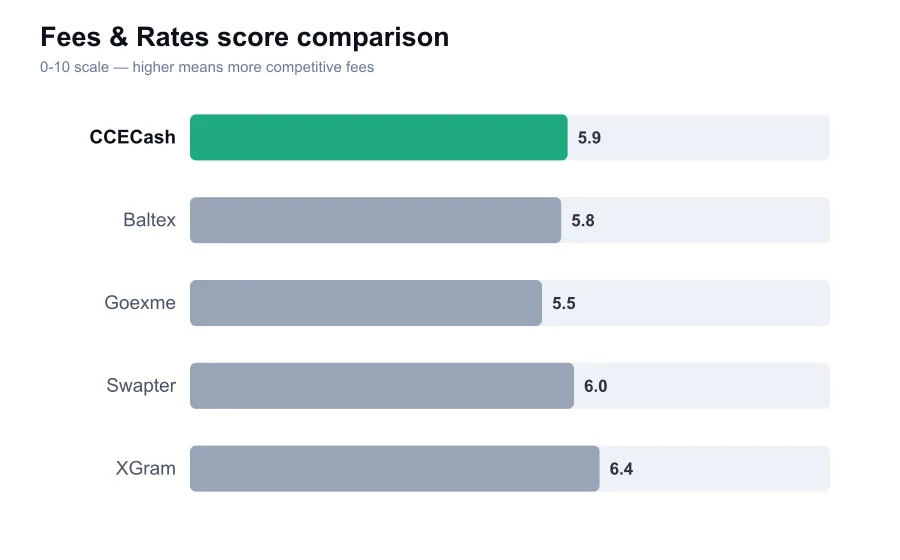
Fees are quote-based. CCECash does not offer the kind of simple maker and taker grid that lets a trader predict cost in advance across a whole month. The margin, route availability and network charge are represented in the amount you are shown. This is convenient, but it can hide a poor rate behind a clean interface. Always compare the exact output against another provider before sending.
This point becomes more important on stablecoin swaps. A user may see USDT, USDC or another token name and assume they are interchangeable, but network fees and route selection can change the economics sharply. A cheaper-looking swap can become expensive if the output is issued on a network that costs more to use or is not accepted by the destination exchange. CCECash cannot protect users from a destination they failed to check.
For speed, the service has the usual advantage of no prolonged account opening. An order can be created quickly, and an automated payout can follow once the incoming deposit is confirmed. But that phrase, once confirmed, does much of the work. Bitcoin confirmation time, Ethereum congestion and a sender's chosen miner fee determine whether the user experiences the swap as rapid or frustrating.
I would be particularly cautious about sending from an exchange that batches withdrawals or applies its own hold. CCECash can only start processing after the source platform actually broadcasts and confirms the transaction. Users sometimes blame the exchange service when the delay was created by the wallet they used to fund the order. Check the source transaction on a block explorer before opening a support request.
CCECash uses temporary custody during an exchange. It is therefore not a decentralized exchange and should not be treated as a self-custody product. The provider receives the deposit, converts it through its internal or liquidity-partner process, then sends the result out. That is a reasonable architecture for convenience, but it introduces counterparty risk for the period in which the funds are in flight.
The service's no-routine-account style is helpful for privacy-conscious users who do not want a standing retail profile at another exchange. Still, this must not be confused with a promise of anonymity. Compliance systems can flag a transaction and request information. A user who has no ability to explain a payment's source should not risk sending it into an exchange flow expecting automatic completion.
Public transparency is the main concern. CCECash does not have the volume of independent security reporting, audited reserve information or public institutional profile associated with top-tier centralized exchanges. That does not prove a defect, but it limits the confidence an outside reviewer can reasonably assign. I prefer services that make it easy to learn who operates them, how they handle suspicious orders and what happens during a delayed payout.
Its reputation is modest. The service has a visible web presence and a straightforward proposition, but it lacks the deeply documented history of older operators such as Alfacash or BitcoinVN. That gap matters more for a large exchange than a very small one. You can sensibly use an unproven provider for a test amount. You should not give it the benefit of the doubt with a sum you cannot afford to see held up.
Support is available through the service's contact channels, yet this is an area where documentation matters as much as friendliness. The user should be ready with the order ID, the deposit hash, the exact amount sent and screenshots of the destination address. CCECash could reduce avoidable tickets by being extremely clear about minimums, supported networks and what to do with an underpayment. Small exchanges need to over-explain edge cases, not under-explain them.
I would not use CCECash for a time-critical business settlement. The potential for confirmation delays, quote movement and compliance review is inherent in the instant-exchange model. For moving a modest balance between personal wallets, the risk is easier to manage. Send a test, wait for the result, then decide whether the route deserves a larger amount.
The best reason to choose CCECash is a favorable real-time quote for a specific supported pair. The worst reason is convenience alone. Plenty of instant exchangers have attractive interfaces, and users should not reward any of them with blind trust. Compare the output, confirm the network, then use the smallest amount necessary.
CCECash is a workable utility for experienced users who understand wallet operations. It scores below long-standing competitors on public track record and disclosure, while remaining capable of handling a basic swap flow. I would use it cautiously for small conversions, not as a primary exchange relationship. A provider in this category earns confidence one transaction at a time.
Criteria Scores
| Criterion | Score | Note |
|---|---|---|
| Fees & Rates | 5.9 | Costs are reflected in the live receive quote. |
| Transaction Speed | 6.5 | Fast setup, subject to source-chain confirmations. |
| Security & KYC Policy | 5.4 | Temporary custody with limited public security disclosure. |
| Reputation & Track Record | 5.0 | A smaller public record than established exchange brands. |
| Customer Support | 5.2 | Keep detailed order evidence for any exception. |
Key Facts
Pros & Cons
| Pros | Cons |
|---|---|
| Fast quote-and-deposit setup | — |
| Useful for simple asset conversions | — |
| No order book required | — |
| Can fit small wallet-to-wallet swaps | — |
Is CCECash a traditional cryptocurrency exchange?
No. CCECash follows an instant exchange model. Users create a quote-based order, send the input asset to a generated address and receive the selected output asset.
Why might a CCECash order still be pending after I sent coins?
The source transaction may still need blockchain confirmations. Bitcoin deposits, Ethereum congestion, exchange withdrawal holds and low network fees can all delay processing.
Does CCECash show a standard trading fee table?
The relevant cost is generally reflected in the live receive quote rather than a conventional maker and taker schedule. Compare the final output amount before depositing.
Can I send stablecoins on any network to CCECash?
No. Use only the network shown in the order instructions. A token with the same name on a different network may not be automatically recoverable.
What details should I save for a delayed CCECash payout?
Keep the order ID, deposit transaction hash, amount sent, source address, destination address and screenshots of the order. These details are needed to trace the transaction.
Can CCECash ask for verification after I deposit?
It may request information if its compliance systems flag a transaction. A no-routine-account exchange flow does not guarantee that every transfer will avoid AML review.