FixedFloat
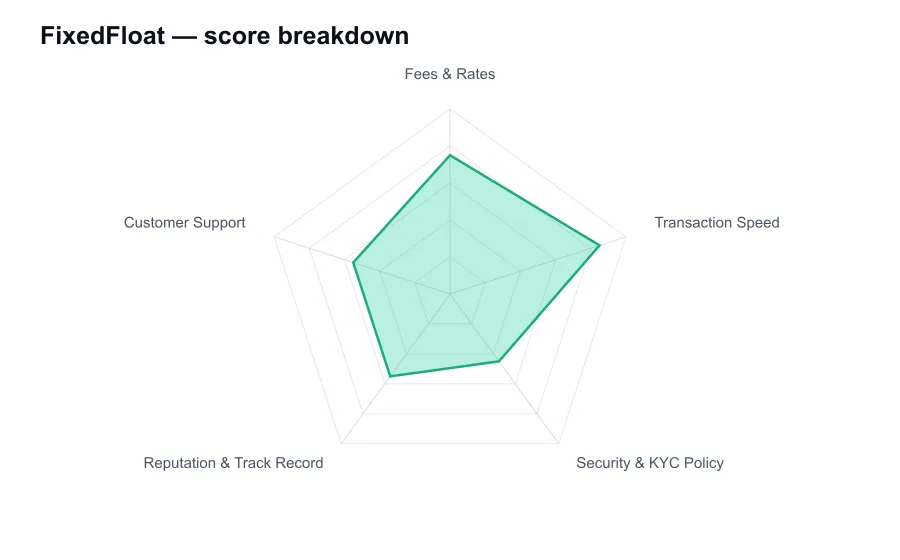
FixedFloat scores 6.4/10 overall in our independent review, measured against every other provider we've compared, strongest on Transaction Speed (8.5/10) and weakest on Security & KYC Policy (4.5/10).
| Best for | Clear 0.5% floating and 1% fixed pricing, Fast automated swaps, Lightning Network support, No standard account registration |
|---|---|
| Not for | Suffered a major reported hack in 2024, No formal customer-protection framework, AML reviews can interrupt a no-account swap, Not suitable for storing funds |
What is FixedFloat?
How FixedFloat Works
- Choose the asset pair and the amount to exchange
- Select a floating or fixed exchange rate
- Enter the destination wallet address
- Send the exact deposit amount to the generated address
- Track confirmations and receive the output asset
KYC
| Requirement | optional |
|---|---|
| Notes | FixedFloat generally permits routine swaps without registration. It may request information or suspend processing where compliance checks identify a transaction risk. |
Supported Assets
| Notable | Bitcoin, Ethereum, Tether, USD Coin, Litecoin, Monero, TRON, BNB |
|---|---|
| Networks | Bitcoin, Lightning Network, Ethereum, Tron, BNB Smart Chain, Polygon |
Limits
| Notes | Minimums are calculated by pair and network conditions. There is no standard account-based daily limit. |
|---|
How to Use FixedFloat Safely
- Run a small test swap before sending a large amount
- Confirm the selected token network matches your sending wallet
- Send the exact amount shown for a fixed-rate order
- Save the order ID and transaction hashes
- Do not use an instant exchanger as long-term storage
Full Review
FixedFloat is a non-custodial instant exchange that sits at the sharper, more technical end of the swap market. It does not ask users to open a normal trading account, maintain a balance, or learn an order-book interface. You choose a pair, receive a deposit address, send coins, and receive the output asset. That simplicity made it popular with users who value privacy and speed, particularly for Bitcoin, Lightning Network, Ethereum, and major stablecoin swaps.
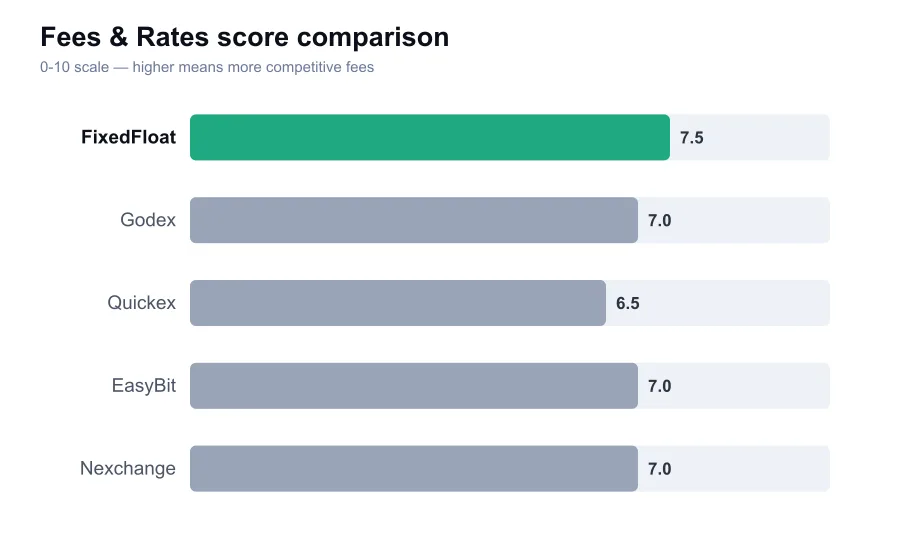
The service's defining feature is its choice of rate model. FixedFloat offers a floating-rate swap at a quoted 0.5 percent service fee, or a fixed-rate swap at 1 percent. Those figures sound straightforward, which is better than the vague pricing used by many instant exchanges. The actual result still includes network fees and the market spread embedded in the quote. A trader should compare the final output amount, not merely the headline percentage.
For a normal floating swap, FixedFloat is often competitively priced. It has historically been especially attractive for Bitcoin and Lightning transactions, where its automated setup can avoid the friction found at account-based exchanges. It is not reliably the cheapest route for every altcoin pair. Services such as ChangeNOW, SimpleSwap, and LetsExchange can occasionally quote more output, depending on which external liquidity provider is being used at that moment.
The fixed-rate option is useful, but users should understand what they are buying. Paying 1 percent does not guarantee that a transaction will finish instantly. It protects the quoted exchange amount if the sender deposits the precise amount before the rate window expires. If the blockchain is congested or the sender uses an inadequate miner fee, the swap can arrive too late to receive the original quote.
Speed is one of FixedFloat's strongest areas. The website has long presented itself as an automated exchange, and routine swaps can be processed quickly after the required blockchain confirmations. Lightning payments can settle in minutes or less. Bitcoin transactions still depend on confirmation time, and Ethereum transfers can be delayed by gas conditions. There is no support agent manually pushing ordinary orders through a queue, which is a strength until something goes wrong.
That last point matters. Fully automated systems feel excellent when every input is correct. They are much less forgiving when a user sends an unsupported token, chooses the wrong network, underpays, or deposits after a fixed-rate timer has elapsed. FixedFloat's interface provides transaction tracking, but there is little of the hand-holding that newcomers get from a large regulated exchange. This is a tool for people willing to take responsibility for each click.
FixedFloat's no-account design is a genuine privacy advantage. Routine transactions generally do not require registration or standard identity verification. That does not mean every transaction is guaranteed to remain free from review. Like other exchange services, it may apply anti-money-laundering checks, request information, or hold an order where its compliance systems identify a risk. Anyone describing it as an absolute no-KYC service is overselling it.
Security is where the review becomes much less comfortable. In February 2024, FixedFloat disclosed an abnormality after large amounts of Bitcoin and Ether left wallets associated with the service. Blockchain investigators and media reports estimated the losses at roughly $26 million. FixedFloat said it had suffered a hack and was working to remove vulnerabilities. For an instant exchanger that depends on users trusting a generated deposit address, that was a serious blow.
The incident does not prove that every present-day swap is unsafe, and FixedFloat continued operating afterward. Still, a hack of that scale changes the standard of proof. A non-custodial exchanger is not the same as a self-custody wallet. During the swap, the provider controls the incoming funds and relies on its own hot-wallet infrastructure, liquidity partners, and operational controls. The 2024 breach means users should avoid treating it as a place to park funds or route unusually large transfers without testing first.
Its reputation before that event was built on convenience, technical features, and a relatively clean interface rather than deep institutional credibility. FixedFloat has been active since 2018, which is meaningful longevity in this corner of crypto. It also developed recognition around Lightning support earlier than many competitors. Yet longevity cannot erase a major security incident, especially when the company remains less transparent than a licensed exchange with published executives, financial reporting, and formal customer protections.
Customer support is available through email and Telegram, with the site directing users to transaction support channels. For simple order-status questions, the automated tracker often provides enough information. The harder cases are where complaints tend to concentrate, including delayed deposits, AML reviews, and recovery requests. Support may be responsive, but a chat channel is not the same thing as a regulated complaints process with defined response deadlines.
The platform's supported assets cover many mainstream coins and tokens, but network selection deserves close attention. Sending USDT on the wrong chain is one of the easiest ways to create an expensive support problem. FixedFloat supports prominent networks including Bitcoin, Ethereum, Tron, BNB Smart Chain, Polygon, and Lightning for relevant assets, yet availability changes by pair. The swap page, not a blog post or third-party listing, should be treated as the live source of truth.
There are no conventional daily account limits because there are no normal user accounts. Minimums are generated for each pair and must cover blockchain fees. Large swaps may be subject to liquidity constraints or compliance review. That flexibility is convenient for ordinary use, but it also means the user does not receive the predictable account tiers, withdrawal rules, or documented protections that a centralized exchange customer would expect.
I still see a place for FixedFloat, particularly for experienced users who need a quick Bitcoin, Lightning, or major-asset swap and understand the operational risks. The fee schedule is clear, execution is usually fast, and the account-free flow is genuinely convenient. But the 2024 hack prevents an enthusiastic recommendation. Use it for limited, time-sensitive swaps after checking the quote, never use it as storage, and choose a more established regulated venue for significant sums.
Criteria Scores
| Criterion | Score | Note |
|---|---|---|
| Fees & Rates | 7.5 | 0.5% floating rate or 1% fixed rate, plus network costs |
| Transaction Speed | 8.5 | Automated swaps and Lightning support can settle quickly |
| Security & KYC Policy | 4.5 | No-account flow, but a major 2024 hack remains concerning |
| Reputation & Track Record | 5.5 | Operating since 2018, with a serious security incident |
| Customer Support | 5.5 | Email and Telegram support, limited recourse in disputes |
Key Facts
Pros & Cons
| Pros | Cons |
|---|---|
| Clear 0.5% floating and 1% fixed pricing | — |
| Fast automated swaps | — |
| Lightning Network support | — |
| No standard account registration | — |
What does FixedFloat charge?
FixedFloat lists a 0.5% fee for floating-rate swaps and 1% for fixed-rate swaps. Network fees and the quoted market rate also affect the final amount received.
Does FixedFloat require KYC?
Routine swaps do not normally require account registration or standard KYC. The service can still request information or review an order under its anti-money-laundering procedures.
What happened to FixedFloat in 2024?
In February 2024, FixedFloat reported a hack after large Bitcoin and Ether outflows. Reports based on blockchain analysis put the loss at about $26 million.
Can I use the Lightning Network on FixedFloat?
Yes. FixedFloat has supported Bitcoin Lightning transactions, which can be much faster than waiting for normal Bitcoin confirmations when the selected pair is available.
Why did my fixed-rate order get a different amount?
A fixed quote depends on sending the exact requested amount within the stated time window. Late arrival, an underpayment, or insufficient blockchain fees can prevent the original rate from applying.
Can I leave crypto in FixedFloat?
No. FixedFloat is designed for swaps, not custody. Send the output directly to a wallet you control rather than treating the service as a balance-holding platform.