Baltex
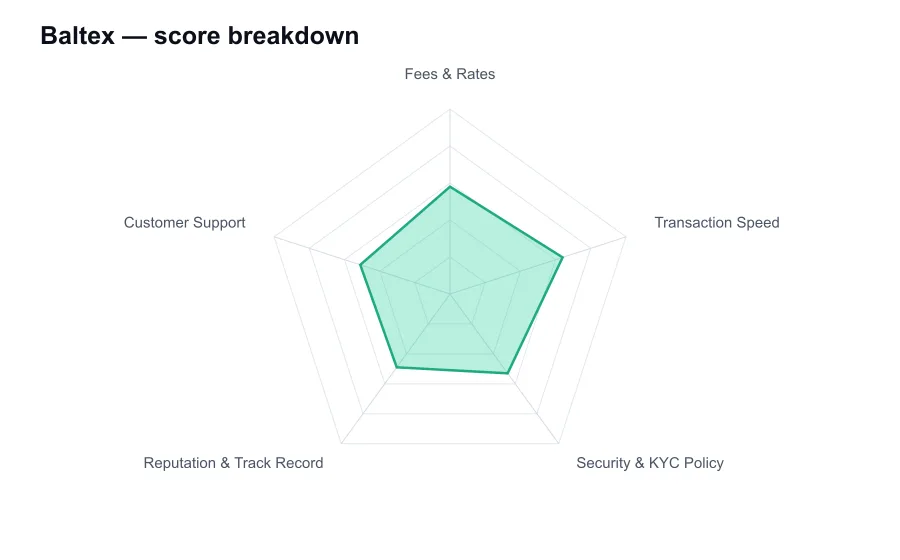
Baltex scores 5.5/10 overall in our independent review, measured against every other provider we've compared, strongest on Transaction Speed (6.4/10) and weakest on Reputation & Track Record (4.9/10).
| Best for | Straightforward quote-and-send flow, No order book to learn, Useful for small one-off conversions, Can be faster than opening a new exchange account |
|---|---|
| Not for | Limited independent transparency, Quoted spreads need close comparison, Thin public reputation relative to larger competitors, Compliance review can interrupt a swap |
What is Baltex?
How Baltex Works
- Choose the crypto asset to send and receive
- Enter the amount and a destination wallet address
- Review the displayed quote and create the order
- Send funds to the deposit address supplied for that order
- Wait for confirmations and payout completion
KYC
| Requirement | tiered |
|---|---|
| Notes | The exchange flow may begin without a full trading account, but AML monitoring can lead to an identity or source-of-funds request. |
How to Use Baltex Safely
- Compare the final output quote against at least two alternatives
- Use a small test transaction before a larger transfer
- Do not reuse deposit addresses from prior orders
- Verify token and network selection character by character
- Keep the order reference and transaction hash until payout arrives
Full Review
Baltex is a small instant crypto exchange service built around the familiar quote-and-send model. It is aimed at people who want a conversion completed without registering for a large trading platform or working through an order book. The service is easy to understand, which is its best feature. It is also a provider where users should be stricter than usual about checking every detail before committing funds.
The name has far less public weight than established instant-exchange operators such as ChangeNOW, Changelly or Swapzone's larger listed partners. That does not automatically make Baltex unsafe. It does mean there is less independent material to lean on if something goes wrong. A buyer cannot substitute a clean interface for a reputation check.
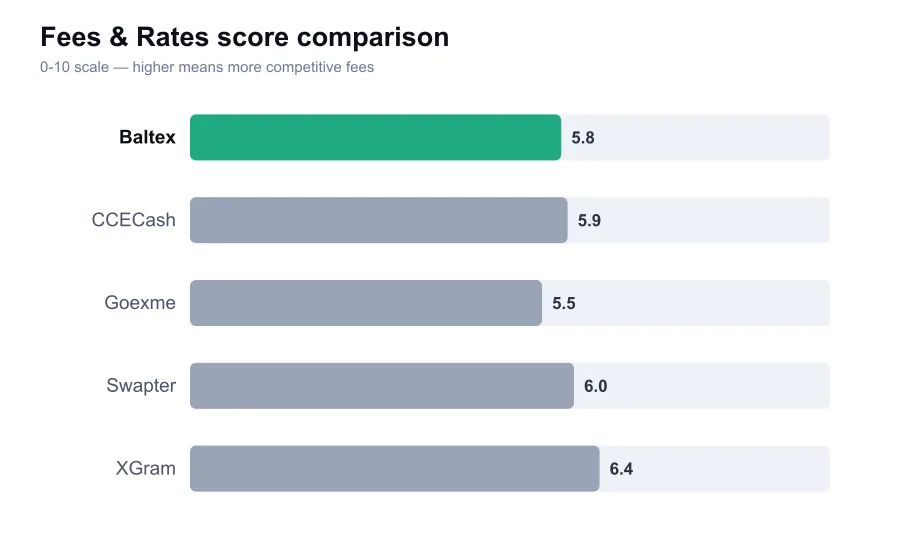
Baltex presents prices as exchange quotes rather than as a transparent maker and taker schedule. This is standard for its category, yet it makes effective cost harder to see. The quoted output includes the provider's margin and may reflect liquidity conditions. Network fees can also affect the final amount. A user who sees a good headline rate but ignores the final receive figure is comparing the wrong thing.
For small conversions, the pricing can be acceptable if Baltex has a competitive route for the selected pair. For larger amounts, I would be reluctant to use it without running side-by-side quotes. A major exchange can often offer better execution for liquid assets after deposit and trading fees are counted, particularly for BTC, ETH and stablecoins. Baltex sells convenience, not consistently best-in-market execution.
The actual transaction flow is uncomplicated. Choose the pair, provide a receiving address, obtain a deposit address, then send funds. That is much faster than account approval at a conventional exchange. It also leaves little room for correction. If you submit an incorrect wallet address, choose a mismatched network, or send less than the required amount, a clean automated transaction can turn into a support case.
Transaction speed depends heavily on the source chain. A swap cannot progress until Baltex sees enough confirmations. Litecoin or many stablecoin transfers can be relatively quick, while Bitcoin can take longer. There is a second delay risk after confirmation if the provider must source a less liquid asset or manually inspect the order. Baltex does not have the published execution transparency that would let a customer judge those exceptions in advance.
Baltex is not a self-custody protocol. Funds are sent to a provider-controlled address for the duration of the exchange. That is an important distinction because some people hear no registration and assume the service is decentralized. It is not. The practical protection is to keep the transfer limited to the amount you actually intend to exchange and send output to a wallet under your control.
Identity verification may be requested where anti-money-laundering checks require it. That possibility deserves direct attention because a swap can become frozen in review after coins have already been sent. A user who cannot or will not supply documents should not assume every quoted order will remain verification-free. This is a business risk common to instant exchangers, though small providers tend to explain the escalation path less well.
Baltex's security posture is difficult to independently assess from public information alone. I have not seen the depth of reporting, proof-of-reserves material, custody explanation or security attestations that one expects from major exchanges. It may employ sensible controls, but an outside user cannot verify much. That keeps my security score in the middle rather than rewarding promises that are hard to examine.
Its reputation is likewise thin rather than clearly poor. Baltex has operated as a recognizable exchange site, but it does not have the broad multi-cycle public record of the category leaders. The distinction matters. A service can process ordinary swaps reliably and still be a weaker choice for an amount that would be painful to have delayed.
Customer support is the real stress test. A successful swap needs no conversation. An uncredited deposit, delayed payout or compliance review does. Baltex provides a support route through its site, but prospective users should set expectations appropriately. Smaller operators usually have fewer public escalation options, fewer independently reported response benchmarks and less ability to absorb a messy edge case gracefully.
I would also avoid sending a combined batch of funds to an old order address. Use the address generated for the exact order and follow the displayed amount instructions. This is the sort of service where operational discipline does more for safety than a password manager or two-factor authentication, because the exchange flow may not involve a persistent user account at all.
There are legitimate reasons to use Baltex. It can save time for a small conversion when its quote is favorable, and the simple interface is easier than a professional exchange. But the market has many alternatives with stronger reputations. Baltex needs to win your transaction through its actual quote and pair availability, not through vague claims of anonymity or speed.
My view is cautious rather than hostile. Baltex is usable as a limited-purpose instant exchanger after a small test transaction. It is not a provider I would choose by default for large purchases, business payments or any transfer that demands a polished compliance process. Treat it as a utility, verify the destination carefully, and keep your exposure modest.
Criteria Scores
| Criterion | Score | Note |
|---|---|---|
| Fees & Rates | 5.8 | Effective cost is embedded in each exchange quote. |
| Transaction Speed | 6.4 | Simple swaps can move quickly after chain confirmations. |
| Security & KYC Policy | 5.3 | Temporary custody and limited public security detail. |
| Reputation & Track Record | 4.9 | A much thinner public record than major rivals. |
| Customer Support | 5.1 | Support exists, but public response evidence is sparse. |
Key Facts
Pros & Cons
| Pros | Cons |
|---|---|
| Straightforward quote-and-send flow | — |
| No order book to learn | — |
| Useful for small one-off conversions | — |
| Can be faster than opening a new exchange account | — |
Does Baltex work like an order-book exchange?
No. Baltex uses a transaction quote flow. You select a pair and amount, send funds to the generated deposit address, then receive the output asset at your chosen address.
Why does the Baltex receive amount matter more than a claimed fee?
The service's effective cost is included in the quoted output and can also be affected by network fees and liquidity. Compare the final amount you will receive across providers.
Can a Baltex exchange be delayed after I send funds?
Yes. Delays can result from blockchain confirmations, a low-fee Bitcoin deposit, less liquid pairs, or a transaction that requires manual AML review.
Should I send funds to a deposit address from an old Baltex order?
No. Create and follow the instructions for the current order. Reusing an old address or combining deposits can complicate automated processing and support recovery.
Is Baltex a decentralized exchange?
No. The service receives the input funds at a provider-controlled address while processing the exchange. Send output to a self-custody wallet if you want control after settlement.
Can Baltex request identity documents?
It may request verification if an order triggers anti-money-laundering procedures. No-registration transaction flows do not guarantee that every transfer will avoid compliance checks.