Swapter
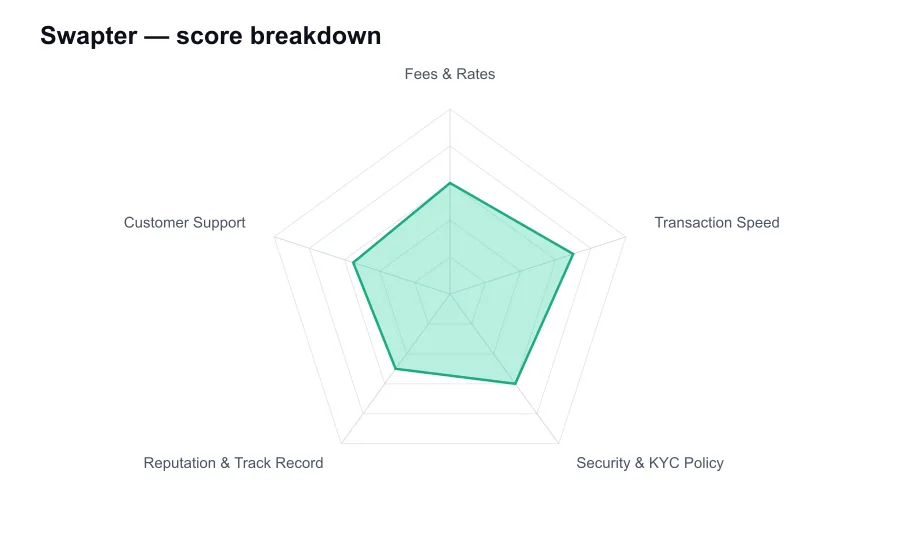
Swapter scores 6.0/10 overall in our independent review, measured against every other provider we've compared, strongest on Transaction Speed (7.0/10) and weakest on Reputation & Track Record (5.0/10).
| Best for | Simple direct wallet-to-wallet swap flow, No conventional exchange account needed, Useful for occasional smaller conversions, Avoids maintaining a platform balance |
|---|---|
| Not for | Limited public track record versus larger rivals, Quote costs are not fully itemized, Not a first choice for large or urgent transfers, Less public evidence of support depth |
What is Swapter?
How Swapter Works
- Select the cryptoasset you want to exchange
- Choose the asset you want to receive
- Enter and verify your receiving wallet address
- Send the input crypto to the provided deposit address
- Monitor the order until the payout is sent
KYC
| Requirement | optional |
|---|---|
| Notes | Direct exchange services can permit orders without conventional registration while still applying transaction screening and requesting information in flagged cases. |
Supported Assets
| Notable | Bitcoin, Ethereum, Tether, USD Coin, Litecoin, Solana |
|---|
How to Use Swapter Safely
- Run a small test transaction before using a new route
- Compare the displayed final payout with established alternatives
- Confirm the asset ticker and blockchain network match exactly
- Keep the order identifier and deposit transaction hash
- Do not use an instant exchanger for a deadline-critical payment
Full Review
Swapter is a smaller instant cryptocurrency exchange provider, built for users who want a quick conversion without registering for a traditional trading venue. It belongs to the same broad group as Quickex, SimpleSwap, and StealthEX, but it has a much lighter public profile than the latter two. That difference matters. A short exchange flow can be attractive, but with a lesser-known provider, the evidence base for judging reliability is thinner.
The core model is simple. The user picks an asset pair, enters a receiving address, sends crypto to a generated address, and waits for the conversion payout. There is no order book to master and usually no standing account to secure. For a person moving a small amount of crypto between wallets, this is easier than using a centralized exchange. It is also less transparent, because the actual trade routing and liquidity source are generally outside the user's view.
Swapter's site presents itself around convenience and straightforward crypto swaps. That can be enough for a low-stakes transaction, but the provider should be evaluated more carefully than its interface might suggest. A clean website does not establish deep liquidity, robust reserves, or strong consumer protections. Those are separate questions. With Swapter, public documentation and independent operating history appear less extensive than the best-known names in this category.
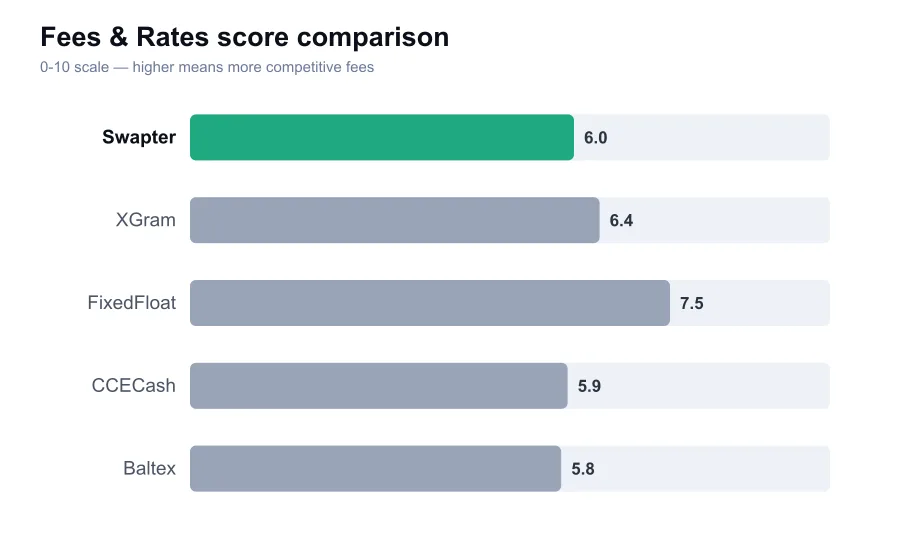
The first thing I would inspect is the quote. Instant exchanges usually build their economics into the rate, and Swapter should be approached the same way. A user may see an estimated payout without a detailed invoice showing provider markup, counterparty spread, and network cost separately. There is nothing inherently improper about that model. But it makes comparison essential. Take the exact same pair and amount, then check it against StealthEX, SimpleSwap, ChangeNOW, or a centralized exchange withdrawal route.
For low-value swaps, a slightly worse rate may be a fair price for speed and simplicity. For larger amounts, it becomes much more consequential. Even a modest gap in the final receive amount can outweigh the convenience of skipping an account login. Swapter does not strike me as a service to use blindly for a large conversion. It may return a fair quote, but a smaller provider has not earned the benefit of the doubt that an established exchange receives after years of observable service.
Speed depends on the same mechanics as every instant exchanger. A deposit has to reach the required confirmations, the provider must execute or route the conversion, and the output transaction must be broadcast and confirmed. Fast chains can make that quick. Bitcoin and Ethereum mainnet can make it slow, particularly if the sender chose a low fee or the network is busy. There is no credible way for Swapter to eliminate those constraints.
The bigger speed concern is exception handling. A known brand with a large support operation may have more established procedures when a deposit is delayed, an amount is short, or a partner cannot fill a route quickly. Smaller providers can still resolve these cases well, but their lower public visibility gives a user less basis for confidence. If a swap is time-critical, use a route where you have already tested the process or trade on a venue with direct order-book access.
Swapter's non-custodial framing should be interpreted carefully. You are not depositing into a personal exchange balance for indefinite storage. That is positive. But during the transaction, the provider receives the input asset and is responsible for delivering the output. The model therefore reduces long-term custody exposure while retaining short-term counterparty risk. It is not equivalent to using a decentralized exchange from a self-custody wallet.
KYC is another area where marketing shorthand can cause trouble. A service may allow orders without creating an account, while still screening transactions and reserving the right to request documents in suspicious, sanctioned, or high-risk cases. Users should review the terms before relying on any claim of anonymity. If documentation cannot be supplied, a compliance hold can become a serious practical problem. This is especially relevant for larger transactions and coins or addresses associated with elevated risk scores.
Swapter's reputation is its weakest scoring area, not because there is a clear public record of a catastrophic failure, but because it has less independently verifiable track record than established alternatives. The absence of widespread complaints is not proof of excellent performance. It may simply reflect a smaller user base. For a service handling irreversible transfers, proven longevity, public support responsiveness, and transparent policy material matter. Swapter has work to do before it belongs in the same trust bracket as the more recognized instant exchange brands.
Support should therefore be tested before it is needed. Check whether the site provides an active contact route, clear order tracking, and written guidance for missed deposits or wrong-network transfers. Keep the order ID and transaction hash from the beginning. If the service offers a live chat, that can be useful, but a fast initial reply is not the same as a resolution. The important question is whether a representative can trace the funds and explain what will happen next.
Asset and network selection deserves special caution with Swapter. Stablecoins are especially easy to mishandle because the same symbol may be issued on Ethereum, Tron, BNB Smart Chain, Polygon, and other networks. A token swap page may look familiar while the deposit details differ completely. Do not assume that USDT is simply USDT. Match the exact chain, verify the expected address format, and use any required memo field where applicable.
For a user who already knows Swapter through a trusted wallet integration or has successfully tested a small order, it can be a convenient option. For a first-time user choosing between providers, I would normally place it behind SimpleSwap or StealthEX because those services have a more developed public footprint. That does not mean Swapter cannot deliver a good transaction. It means the burden of caution is higher, and the user should not send a life-changing amount to prove a point.
My take is blunt: Swapter is suitable for carefully checked, modest swaps, not for unquestioning trust. The product model is useful and the direct exchange flow is easy, but the provider's thinner track record calls for conservative behavior. Compare its final quote, test it with a small amount, and avoid using it for a deadline-sensitive or very large transfer. Until it has accumulated more visible operational history, convenience is its case, not reputation.
Criteria Scores
| Criterion | Score | Note |
|---|---|---|
| Fees & Rates | 6.0 | Quote-based pricing requires direct comparison before sending. |
| Transaction Speed | 7.0 | Normal swaps depend on blockchain confirmations and routing liquidity. |
| Security & KYC Policy | 6.0 | No standing balance, but users retain intermediary and review risk. |
| Reputation & Track Record | 5.0 | Smaller public footprint than established instant-exchange rivals. |
| Customer Support | 5.5 | Keep order records, public evidence of support depth is limited. |
Key Facts
Pros & Cons
| Pros | Cons |
|---|---|
| Simple direct wallet-to-wallet swap flow | — |
| No conventional exchange account needed | — |
| Useful for occasional smaller conversions | — |
| Avoids maintaining a platform balance | — |
Does Swapter require a trading account?
Swapter is designed for direct exchange orders rather than a conventional account-based trading balance. You provide a destination wallet address for the payout.
Are Swapter's fees shown as a flat percentage?
The relevant cost is usually reflected in the quoted payout. Compare the exact final amount against other instant exchangers before submitting an order.
Should I use Swapter for a large first transaction?
A small test transaction is the safer approach. Swapter has a lighter public track record than larger rivals such as SimpleSwap and StealthEX.
What if my deposit has not confirmed yet?
The exchange cannot normally process the order until the inbound transaction receives the required blockchain confirmations. Check your transaction hash on the relevant explorer.
Can a no-account swap still be reviewed for compliance?
Potentially, yes. Account-free checkout does not rule out transaction screening or a request for documents in a flagged case.
Why must I choose the exact USDT network?
USDT exists on several blockchains. Sending USDT on a chain not shown in the order instructions can delay recovery or make the deposit unrecoverable.