Godex
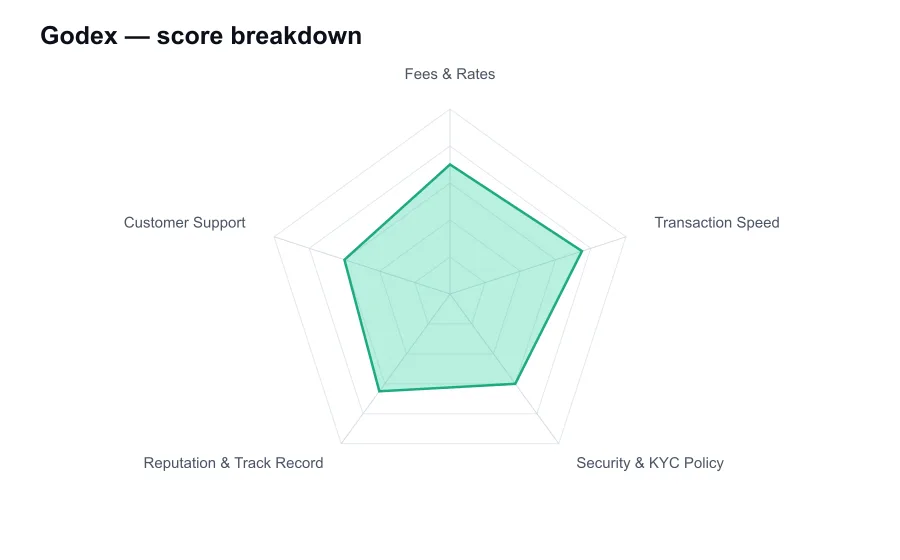
Godex scores 6.7/10 overall in our independent review, measured against every other provider we've compared, strongest on Transaction Speed (7.5/10) and weakest on Customer Support (6.0/10).
| Best for | Advertised 0.5% exchange fee, Fixed-rate order model, No standard registration, Wide crypto pair selection |
|---|---|
| Not for | Final output can include market spread, Limited corporate and security transparency, No fiat onboarding, Compliance checks can delay a swap |
What is Godex?
How Godex Works
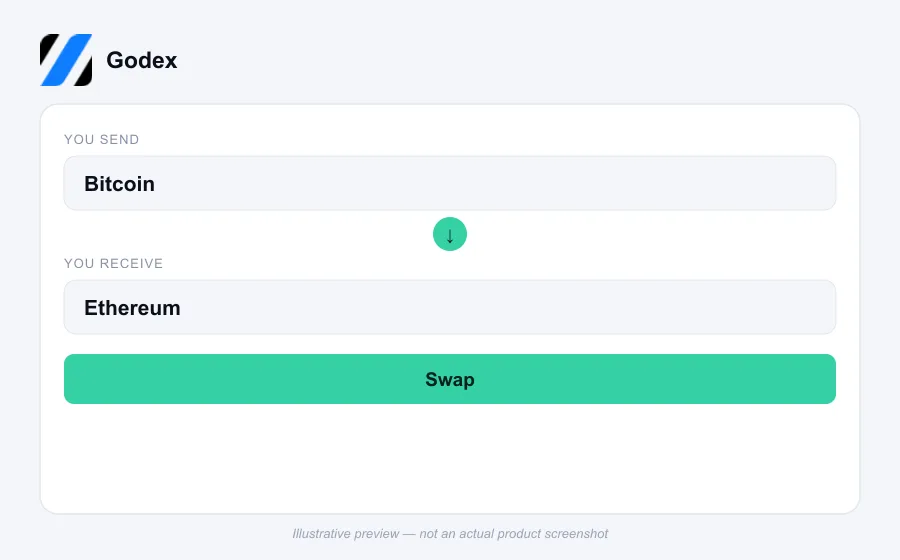
- Select the cryptocurrency pair and desired amount
- Enter a destination address for the asset you will receive
- Review the fixed-rate quote and create the order
- Send the requested crypto amount to the deposit address
- Wait for confirmations and delivery to your wallet
KYC
| Requirement | optional |
|---|---|
| Notes | Godex does not normally require registration for standard swaps. Its compliance procedures can still result in an order review or a request for supporting information. |
Supported Assets
| Notable | Bitcoin, Ethereum, Tether, USD Coin, Litecoin, Monero, TRON, Dogecoin |
|---|
Limits
| Notes | Minimum and maximum amounts depend on the selected pair, network costs, and available liquidity shown when an order is created. |
|---|
How to Use Godex Safely
- Compare the final received amount with at least one alternative
- Check the asset ticker and blockchain network carefully
- Use a test transaction for a new wallet or large transfer
- Send the exact amount shown before the rate window closes
- Keep the order ID and both transaction hashes
Full Review
Godex is a straightforward instant crypto exchange aimed at users who want to swap assets without creating a conventional account. Its pitch is familiar: choose a pair, enter a receiving address, transfer funds to a generated address, and wait for delivery. What distinguishes Godex from many lookalike swap sites is its long-running focus on fixed exchange rates and a deliberately stripped-down interface.
The service has operated since 2018, which gives it more history than many anonymous-looking exchange widgets. That does not put it in the same trust category as Kraken, Coinbase, or Bitstamp. Godex is an exchange intermediary rather than a regulated full-service venue, and users do not get a named account manager, segregated customer balances, or the legal protections associated with a licensed broker.
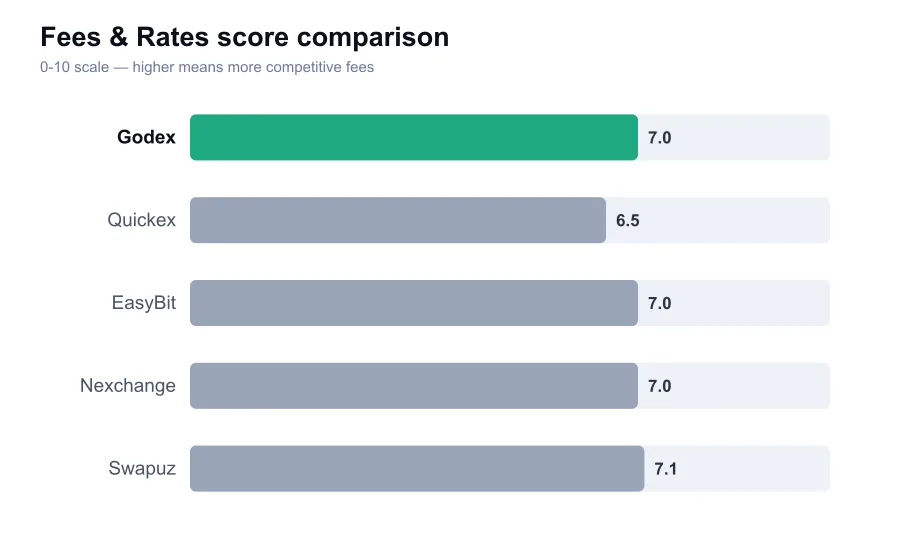
Godex advertises a fixed rate and a 0.5 percent exchange fee. That is a clean claim, and clarity is welcome in a part of crypto where providers often obscure their economics behind phrases such as best rate. The catch is that the visible rate can include a liquidity-provider spread before the 0.5 percent is applied. Compare the final amount received with at least one alternative before committing, especially for stablecoin swaps or large Bitcoin transactions.
In many ordinary comparisons, Godex is neither absurdly expensive nor reliably the cheapest option. It tends to be reasonable for convenient one-off swaps, but it can lose on output to a live order book or to a sharp aggregator. Users exchanging a few hundred dollars may find the difference negligible. Users moving five figures should care about every decimal place and should request several quotes from Godex, LetsExchange, ChangeNOW, and a trusted centralized exchange.
Godex's fixed-rate model is its practical selling point. The rate is set for a limited period after an order is created, reducing exposure to abrupt price movements while the deposit is waiting for confirmations. That is useful in volatile markets. It does not absolve the sender from using adequate network fees or sending the exact amount. A late deposit can turn an apparently simple order into a manual-support case.
Transaction speed is respectable for an automated exchanger, but the word instant needs translation. Godex cannot send out coins until it sees the incoming transfer and, where relevant, obtains enough confirmations. Litecoin and Tron swaps may feel quick. Bitcoin can take far longer during congestion, and ERC-20 swaps can be slowed by expensive Ethereum blocks. The service is fast after confirmation, not magically independent of the chains it uses.
The site has promoted access to hundreds of cryptocurrencies, which is useful for users holding older altcoins that are awkward to trade at a major exchange. Broad coverage is also a risk point. Asset support is not uniform across chains, liquidity can be thin for obscure pairs, and a token sharing a familiar ticker with another asset can create costly mistakes. Check the deposit network and destination format before sending anything.
Godex generally does not require a user account or ordinary identity verification for a standard exchange. That is a legitimate convenience for privacy-minded users. It should not be confused with immunity from compliance controls. A transaction flagged by risk systems may be delayed and can trigger a request for documentation. The service's terms reserve room for this, as they should, but the result can be frustrating for someone who assumed no registration meant no possibility of a hold.
Security is adequate for the category, not exceptional. Godex does not hold a standing user balance in the way a custodial exchange does, which reduces the risk of account takeovers and exchange-bankruptcy exposure. But it receives the deposited cryptocurrency during the trade. The user must trust its website, its address-generation process, its hot-wallet security, and its partner liquidity routes for the duration of the swap.
I would not call Godex a high-transparency operation. Publicly available corporate detail is limited compared with regulated competitors, and the company does not have the deeply documented security programs, proof-of-reserves reporting, or public leadership footprint that cautious users might want. Its track record is better described as quietly established than strongly verifiable. That is enough for small swaps, but it limits confidence for serious capital.
Customer support is available around the clock through the site's chat and email channels. For routine questions, that is appropriate. Reports from users are mixed in the predictable way for instant exchangers: successful swaps receive little fanfare, while delayed transactions and compliance reviews create angry reviews. The important practical reality is that support is your only path if something goes wrong. There is no account dashboard with formal dispute escalation or telephone dealing desk.
Godex does not support fiat deposits, card purchases, margin trading, staking, or a normal portfolio account. That is not a weakness if all you need is a wallet-to-wallet exchange. It is a weakness if you are a beginner who needs to buy their first crypto with euros or dollars. The platform assumes you already possess crypto and already know how to manage an external wallet.
The best use of Godex is a reasonably sized exchange between established assets where the quote is competitive and the receiving wallet is ready. It is particularly useful for someone who values a fixed quote more than a trading interface. I would not route a life-changing amount through it in one transfer, and I would not use it for exotic tokens without first checking that the precise network is supported.
My view is that Godex is a competent utility rather than a destination exchange. Its fixed-rate structure and 0.5 percent stated fee make it easier to judge than many competitors. Speed is usually acceptable, and the no-account flow is convenient. The trade-off is limited transparency and limited recourse. Use it deliberately, compare quotes, and keep your expectations aligned with what it is: an automated swap service, not a full financial institution.
Criteria Scores
| Criterion | Score | Note |
|---|---|---|
| Fees & Rates | 7.0 | Advertises a 0.5% fee, but compare final quotes for spread |
| Transaction Speed | 7.5 | Automated processing after the required confirmations |
| Security & KYC Policy | 6.0 | No standing balances, but limited public transparency |
| Reputation & Track Record | 6.5 | Operating since 2018 with a modest public footprint |
| Customer Support | 6.0 | 24/7 chat and email, but no formal escalation route |
Key Facts
Pros & Cons
| Pros | Cons |
|---|---|
| Advertised 0.5% exchange fee | — |
| Fixed-rate order model | — |
| No standard registration | — |
| Wide crypto pair selection | — |
What fee does Godex charge?
Godex advertises a 0.5% exchange fee. The final amount can also reflect the quoted market rate, liquidity-provider pricing, and the relevant blockchain network fee.
Does Godex require KYC?
Godex generally allows standard swaps without account registration or ordinary KYC. It may still request documents or place an order under review if compliance controls flag a transaction.
Is the Godex rate really fixed?
Godex presents fixed-rate exchanges for a limited order window. You must send the exact requested amount promptly. A late or incorrect deposit can require repricing or support intervention.
Why is a Bitcoin swap taking longer than a Tron swap?
Godex must wait for incoming blockchain confirmations. Bitcoin confirmation time varies with block production and network fees, while Tron transfers often confirm more quickly.
Can I buy crypto with a bank card on Godex?
Godex is primarily a crypto-to-crypto exchange. It is not a conventional fiat on-ramp with bank-card deposits and a persistent account balance.
Should I send an obscure token to Godex?
Only after confirming the exact asset and network on the live order page. Broad coin support does not mean every version of a token or every chain is accepted.