Goexme
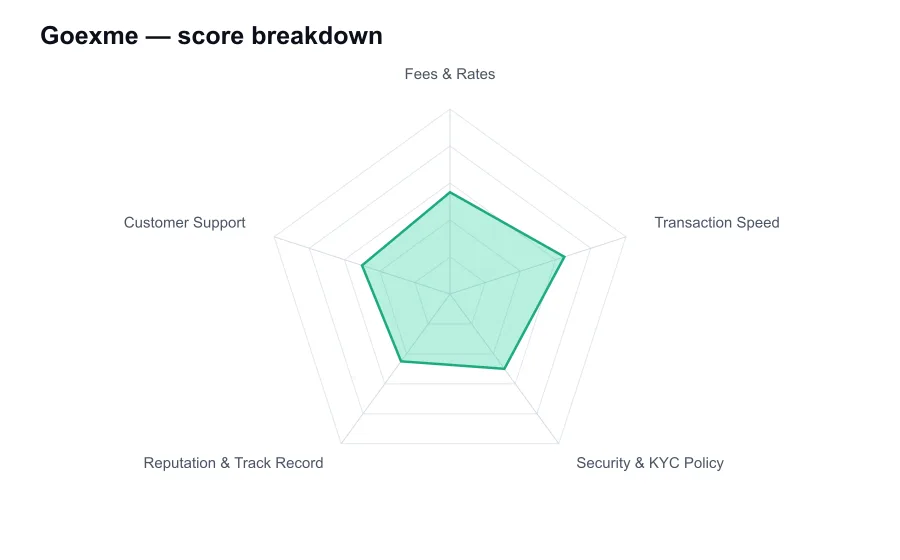
Goexme scores 5.3/10 overall in our independent review, measured against every other provider we've compared, strongest on Transaction Speed (6.5/10) and weakest on Reputation & Track Record (4.5/10).
| Best for | Simple wallet-to-wallet exchange flow, No conventional trading account, Useful for small direct swaps, Receives output in an external wallet |
|---|---|
| Not for | Limited publicly verifiable company history, No transparent universal fee schedule, Weak evidence of mature support infrastructure, Not suitable for high-value transfers |
What is Goexme?
How Goexme Works
- Select the cryptocurrency and network you want to send
- Choose the asset and network you want to receive
- Enter and verify your destination wallet address
- Review the displayed quote and create the order
- Send crypto to the generated deposit address
- Track the order until funds arrive in your wallet
KYC
| Requirement | optional |
|---|---|
| Notes | Goexme presents a low-friction exchange flow without normal trading-account onboarding. Transactions can still be reviewed under compliance or anti-fraud procedures. |
Limits
| Notes | Transaction minimums and maximums may vary by asset, network fee, and available liquidity displayed for a specific order. |
|---|
How to Use Goexme Safely
- Make a small test exchange before sending a large amount
- Verify the token network, especially for stablecoins
- Compare the final quote with established competitors
- Copy the receiving address carefully and check its first and last characters
- Keep the order page, transaction hash, and support correspondence
Full Review
Goexme is a small instant cryptocurrency exchange service, not a traditional centralized exchange with accounts, charts, or a long public operating history. The flow is simple: users select the coin they are sending, choose the coin they want back, enter a wallet address, and fund a one-time deposit address. It occupies a crowded market already served by larger brands such as ChangeNOW, LetsExchange, SimpleSwap, and Godex.
That market position is important because Goexme has little room for error. A new or lightly documented exchange service must beat established competitors on price, speed, asset availability, or support to justify the extra trust required. Goexme's site is easy to understand, but ease of use alone is not a meaningful moat. Plenty of competitors offer a similar interface, broader liquidity, and a more substantial public track record.
The service presents itself as a straightforward crypto swap platform and typically quotes the output amount before an order is created. Like most instant exchangers, the exact economics are not as transparent as a conventional maker and taker fee schedule. The quote can reflect a service margin, market spread, partner-exchange routing, and network fees. That makes it difficult to assign a single universal fee percentage with confidence.
For that reason, Goexme should be judged quote by quote. If the final amount received is better than the alternatives for your exact pair, it may be a perfectly functional route. If it is not, there is no reason to pay a premium merely because the site looks clean. A small difference in quoted output can become expensive on a larger swap, particularly for Bitcoin, Ether, or stablecoin conversions where a user may assume pricing is uniform.
Speed depends heavily on the chains involved and on the provider's liquidity route. A transfer on Tron, Solana, or a fast Layer 2 can be processed fairly quickly once the deposit is seen. Bitcoin and Ethereum may take longer, especially if the sender uses a low network fee. Goexme does not control block production, and any review, wallet maintenance issue, or partner delay can turn an expected quick swap into a waiting exercise.
The platform is best understood as an automated exchange intermediary. It is not a decentralized exchange where the user trades directly from a wallet through smart contracts. During the exchange process, the service receives the deposited funds and arranges delivery of the output. That means the user is exposed to operational risk for the duration of the order, even if there is no long-term account balance.
Goexme's apparent no-registration approach is attractive to people who dislike handing over personal data for every crypto transaction. Still, users should not confuse a low-friction start with a binding promise that verification will never be requested. Crypto exchange services generally reserve the ability to investigate suspicious or legally risky transfers. If documentation is requested after funds have been sent, the user has little leverage beyond the provider's support process.
The biggest concern is not a known major hack or a clearly documented scandal. It is the lack of independently verifiable depth. Goexme does not have the public history, detailed company disclosures, broad media coverage, or extensive technical reporting that make a reviewer comfortable recommending it for large transfers. Absence of a public disaster is not evidence of mature controls. It can simply mean the service is smaller and less scrutinized.
This does not make Goexme automatically unsafe. Smaller providers can execute swaps properly, and many users only care about the narrow task of converting one coin to another. But a prudent reviewer should distinguish between functional and proven. Goexme appears functional as an instant-swap service. It is not proven to the same degree as a long-standing major exchange, and it has not earned the benefit of the doubt for high-value transactions.
Customer support is especially important in that context. Goexme provides online support contact options through its website, which is better than an entirely anonymous swap page. What is missing is the kind of visible support infrastructure that reassures a customer facing a difficult recovery case: a robust public help center, formal complaint path, published service-level standards, or widely documented response history. If a transfer is delayed, users should expect to rely on email or chat rather than a sophisticated case-management system.
Asset and network selection should be treated with caution. The list displayed on an instant exchange can change based on liquidity and wallet availability. Tether is the classic trap because USDT exists on several chains, including Ethereum, Tron, and BNB Smart Chain. A user must not assume that choosing USDT is sufficient. The network selected on the Goexme order must match the network used by the sending wallet.
There is also no reason to use Goexme as a wallet, savings product, or all-purpose trading venue. It does not replace a self-custody wallet for storage, and it does not replace a regulated exchange for recurring fiat purchases or deep liquidity. Its rational use case is much narrower: a one-time crypto exchange where the quote is competitive and the user wants to receive funds directly into a wallet they control.
For a first transaction, I would send the smallest practical test amount, confirm the destination address, and save the order ID before closing the browser. That advice applies to every instant exchanger, but it matters more at a provider with a lighter public track record. Do not send funds from a chain or token contract you have not confirmed. Do not assume support can reverse an on-chain mistake.
My assessment of Goexme is cautious rather than hostile. It may be useful for smaller, uncomplicated swaps, and its low-friction format will appeal to users who already understand self-custody. It has not supplied enough public evidence to rank alongside the category's better-known names on security or reputation. Use it only after comparing the live quote, keep transaction sizes conservative, and choose a more transparent venue when the amount matters.
Criteria Scores
| Criterion | Score | Note |
|---|---|---|
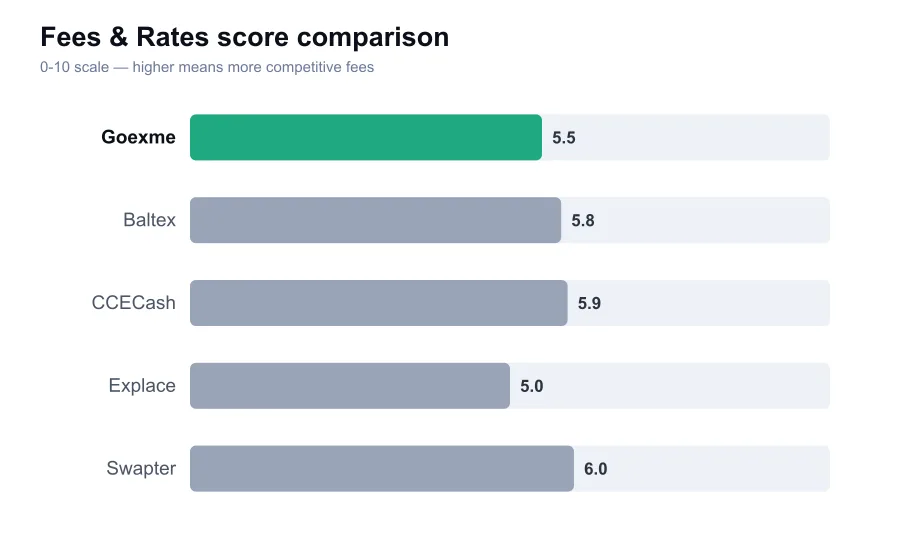
| Fees & Rates | 5.5 | Quote-based pricing, with no clearly verifiable universal fee |
| Transaction Speed | 6.5 | Automated swaps, but timing depends on networks and routing |
| Security & KYC Policy | 5.0 | No-account convenience, limited public security disclosure |
| Reputation & Track Record | 4.5 | Thin independently verifiable public track record |
| Customer Support | 5.0 | Website contact support, little visible escalation structure |
Key Facts
Pros & Cons
| Pros | Cons |
|---|---|
| Simple wallet-to-wallet exchange flow | — |
| No conventional trading account | — |
| Useful for small direct swaps | — |
| Receives output in an external wallet | — |
Does Goexme have a published flat exchange fee?
Goexme uses quote-based pricing for swaps. A single verified flat fee is not clearly established, so compare the final amount you will receive against other services before sending funds.
Does Goexme require KYC?
The service is designed around a low-friction crypto swap flow rather than conventional account onboarding. Compliance checks can still apply if a transaction is flagged.
Can I keep funds on Goexme?
Goexme is intended for one-time exchanges to an external wallet. It should not be used as a storage wallet or as a place to maintain a long-term crypto balance.
Why should I make a test swap first?
Goexme has a lighter public track record than major exchanges. A small test verifies the selected network, receiving address, and the practical speed of the route before more funds are exposed.
Can I send USDT from any network?
No. USDT exists on multiple networks. The network selected in the Goexme order must exactly match the network used by your sending wallet.
What happens if the blockchain is congested?
The swap may take longer because Goexme needs to detect and process the incoming transfer. Bitcoin and Ethereum transactions can be delayed if the sender uses a low network fee.