Simpleswap
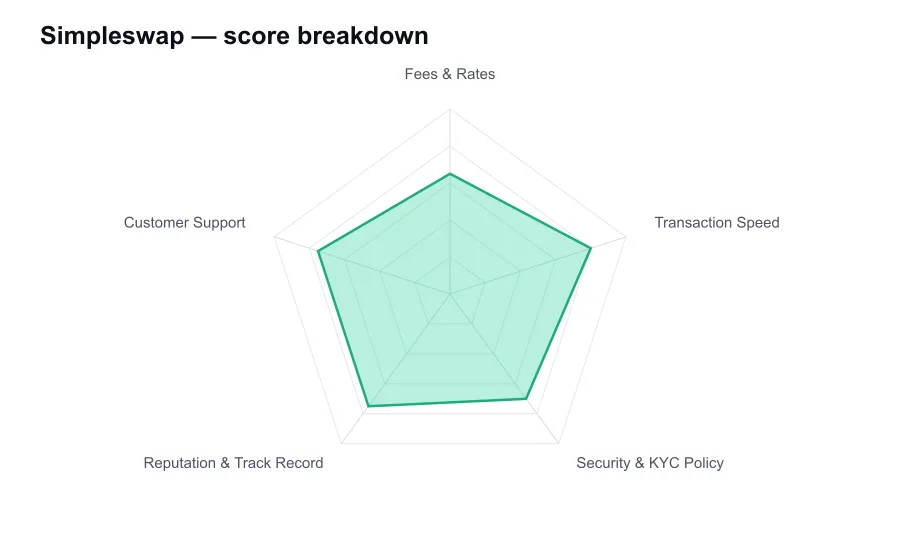
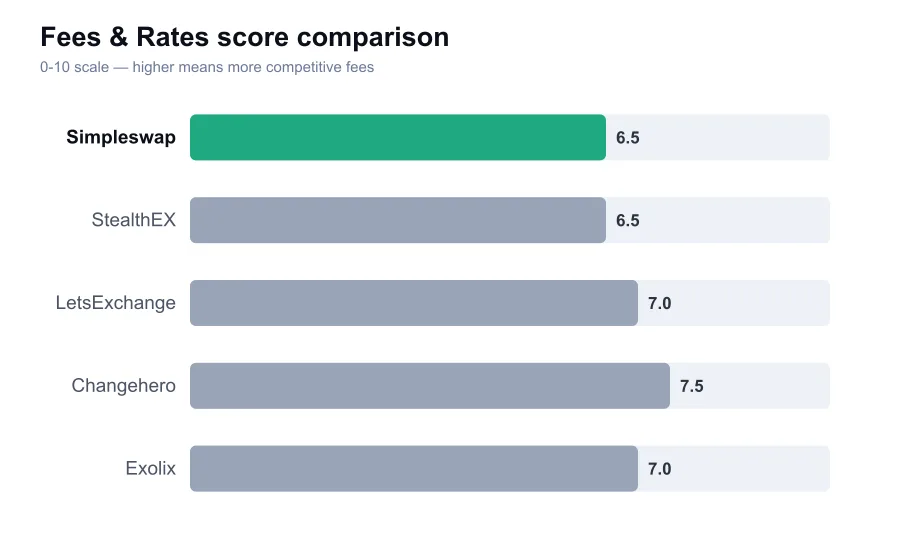
Simpleswap scores 7.2/10 overall in our independent review, measured against every other provider we've compared, strongest on Transaction Speed (8.0/10) and weakest on Fees & Rates (6.5/10).
| Best for | Recognizable established instant-exchange brand, Floating and fixed-rate swap modes, No routine account registration, Useful help center and support channels, Wallet and widget integration presence |
|---|---|
| Not for | No granular public fee schedule, KYC may be requested after transaction screening, Floating rates can change before settlement |
What is Simpleswap?
How Simpleswap Works
- Pick the cryptocurrency pair and desired amount
- Choose fixed or floating rate if both are offered
- Provide the wallet address for the asset you will receive
- Send the input asset to the order deposit address
- Track confirmations and wait for the payout transaction
KYC
| Requirement | optional |
|---|---|
| Notes | SimpleSwap can be used without routine registration, but its AML procedures may require verification for transactions that trigger compliance review. |
Supported Assets
| Notable | Bitcoin, Ethereum, Tether, USD Coin, BNB, Solana, Litecoin, Monero |
|---|---|
| Networks | Bitcoin, Ethereum, Tron, BNB Smart Chain, Solana |
How to Use Simpleswap Safely
- Confirm whether your quote is fixed or floating before paying
- Match the token and blockchain exactly, especially for stablecoins
- Check the minimum deposit shown on the order page
- Keep the order ID and input transaction hash
- Try a smaller order before sending a large amount
Full Review
SimpleSwap is one of the better-known names in the instant exchange category. It offers crypto-to-crypto conversions through a straightforward interface, with no need to operate an order book or keep a standing custodial balance. The pitch is familiar: choose a pair, send the input asset, and receive the output asset in your own wallet. It targets casual users, wallet users, and people making one-off conversions rather than professional traders.
The company has been around longer than many smaller swap widgets, and that matters. In this sector, a recognizable brand and a developed help center count for something because users frequently arrive only after they have already sent money. SimpleSwap's interface is polished, its exchange widget is widely used, and its integrations have helped it become more visible than a typical anonymous instant exchanger.
Its pricing is the main reason to compare before committing. SimpleSwap offers floating and fixed-rate exchange modes, but neither should be mistaken for a published exchange-fee schedule. The cost is reflected in the quote and can include a provider margin, liquidity partner pricing, and blockchain withdrawal expense. For a user making an occasional conversion, that can be acceptable. For someone converting regularly, the accumulated difference versus a low-fee centralized exchange can be significant.
The floating-rate route is often more flexible and may show a better initial number, but it places market risk on the user. If the input asset falls or the output asset rises while the transaction is processing, the final amount can be lower than expected. Fixed-rate mode is the sensible choice for users who need a known payout, though it can cost more and requires the deposit to arrive under the conditions shown in the order. Read the timer and required amount rather than rushing through the page.
SimpleSwap's best fee-related advantage is not absolute cheapness. It is easy comparison. The site presents the expected receive amount clearly enough for a user to put it beside ChangeNOW, StealthEX, or a direct exchange withdrawal quote. That is how this service should be used. Do not ask whether its rate looks reasonable in isolation. Ask whether the actual number landing in your wallet is better than the alternatives available at that moment.
Transaction speed is generally good for popular pairs. A swap can move quickly once the inbound transfer has received sufficient confirmations. Fast chains such as Tron or Solana can make the whole process feel nearly immediate. Bitcoin transactions, Ethereum mainnet congestion, wallet broadcast delays, and liquidity checks are slower. The phrase instant exchange describes the checkout experience better than it describes blockchain settlement.
There are two different causes of delay that users often conflate. The first is a blockchain issue, such as a low network fee or an unconfirmed BTC deposit. The second is a platform or liquidity issue, where the provider needs longer to source the asset or a compliance system has flagged the transaction. SimpleSwap cannot control the former, and it should communicate clearly about the latter. Its support documentation does a reasonable job explaining normal processing stages, though real-time certainty is still limited.
On security, SimpleSwap is better understood as a transactional intermediary than as a self-custody protocol. It does not ask users to leave a permanent portfolio on the platform, which reduces the temptation to hold funds with an exchange. During the swap, however, the user transfers assets into a process controlled by the provider and its partners. That means the exchange is not trustless, and users retain counterparty exposure until their output transaction is broadcast.
The no-sign-up message also needs context. SimpleSwap can process many orders without registration, but it applies anti-money-laundering controls and may request KYC documentation for suspicious or high-risk activity. This is an important practical distinction. A privacy-minded user may appreciate that there is no routine account creation, but someone who cannot or will not complete verification should not send an amount that would be damaging to have paused.
SimpleSwap has attracted a substantial volume of public user feedback over the years. That produces a familiar picture: many people report clean, fast exchanges, while a minority report delayed orders, rate surprises, or disputes connected to compliance checks. I do not see that as unique evidence against the company. It is inherent to an industry where the smooth transactions generate little discussion and the difficult ones generate long complaint threads. Still, its larger public footprint gives users more material to assess than newer rivals.
The service has made visible efforts around support, including a help center and live-chat style contact options. That is a real advantage over smaller exchanges that offer little beyond a form and an email address. Yet support quality is most important in exceptions, and those exceptions are where every instant exchanger can disappoint. A representative can explain a pending transaction, but cannot always release a swap while a compliance review or partner-side issue remains open.
SimpleSwap is also a common choice for wallet integrations and API-style exchange widgets. This is useful for users who discover it within a wallet they already trust. It should not make them complacent. A wallet integration can simplify the handoff, but the quote, minimum, network, and destination details still need checking. In particular, token tickers that exist on multiple chains deserve attention. USDT on Ethereum, Tron, BNB Smart Chain, and other networks is not interchangeable.
I rate SimpleSwap above many little-known instant exchangers because the product is mature, the interface is accessible, and the company has established a recognizable operating history. I do not rate it as a low-cost trading venue, because it isn't one. People who insist on exact execution, transparent fee accounting, or fiat banking access should look to a regulated centralized exchange. Users who want a reasonably polished wallet-to-wallet swap service will find SimpleSwap credible if they compare rates and avoid careless network errors.
My view is that SimpleSwap earns its place as a convenience provider, not as a default destination for every conversion. It is strongest for ordinary, liquid swaps where speed and low friction matter more than squeezing out every basis point. Use fixed rate when the amount matters, use floating rate only if you accept movement, and keep transaction evidence until completion. That approach gets the best out of the service while respecting the risks that come with this exchange model.
Criteria Scores
| Criterion | Score | Note |
|---|---|---|
| Fees & Rates | 6.5 | Rates are competitive at times, but costs are embedded in the quote. |
| Transaction Speed | 8.0 | Fast processing for liquid pairs once inbound funds confirm. |
| Security & KYC Policy | 7.0 | No standing user balance, with AML checks for flagged orders. |
| Reputation & Track Record | 7.5 | One of the more established names in instant crypto swaps. |
| Customer Support | 7.5 | Help center and chat-style support improve exception handling. |
Key Facts
Pros & Cons
| Pros | Cons |
|---|---|
| Recognizable established instant-exchange brand | — |
| Floating and fixed-rate swap modes | — |
| No routine account registration | — |
| Useful help center and support channels | — |
| Wallet and widget integration presence | — |
Does SimpleSwap charge a visible flat fee?
SimpleSwap generally presents the expected payout in its quote rather than a universal flat percentage fee. Compare the final receive amount across providers.
Can I use SimpleSwap without KYC?
Many ordinary swaps can be started without account registration, but AML screening can result in a request for identity or source-of-funds documentation.
What is the difference between fixed and floating rate?
A fixed-rate order aims to preserve the quoted payout if its deposit conditions are met. A floating-rate order can settle at a different market rate.
Why is my SimpleSwap order waiting for confirmation?
The input transaction may still need blockchain confirmations. Bitcoin and congested Ethereum transfers often take longer than transfers on faster networks.
Can I exchange USDT between different networks?
Only select the exact USDT network supported in the order. USDT on Tron and USDT on Ethereum use different blockchains and are not interchangeable deposits.
Is SimpleSwap suitable for day trading?
No. It is intended for conversions, not active trading. Traders usually get more execution control and lower explicit fees from a liquid exchange.