Trocador
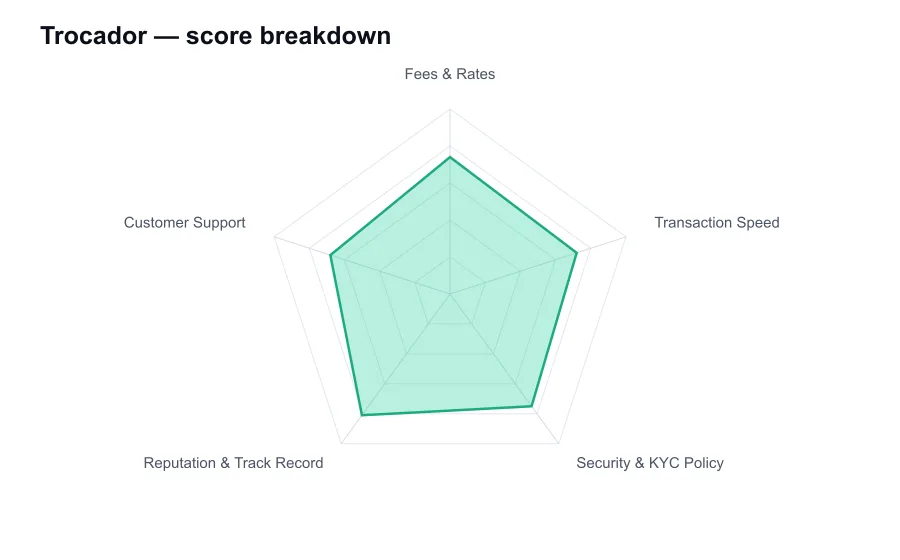
Trocador scores 7.5/10 overall in our independent review, measured against every other provider we've compared, strongest on Reputation & Track Record (8.1/10) and weakest on Customer Support (6.8/10).
| Best for | Compares multiple exchange-provider quotes, Clear 0.5% platform fee, KYC and rate-type route indicators, Tor access and Monero-friendly positioning, Strong recognition in the privacy community |
|---|---|
| Not for | 0.5% fee can exceed spot-market costs, The chosen partner controls trade execution, A KYC-free route can still face compliance review |
What is Trocador?
How Trocador Works
- Enter the asset, amount, and network you want to send
- Choose the asset and network you want to receive
- Compare provider quotes, rate types, and KYC indicators
- Enter your receiving wallet address and create the order
- Send funds to the displayed deposit address
- Track the selected provider's swap until payout arrives
KYC
| Requirement | optional |
|---|---|
| Notes | Trocador does not normally require account KYC. Its exchange partners have independent policies and can request documents for transactions that trigger compliance review. |
Supported Assets
| Notable | Bitcoin, Monero, Ethereum, Tether, USD Coin, Litecoin, Dash, Zcash |
|---|---|
| Networks | Bitcoin, Ethereum, Tron, Litecoin, Monero |
How to Use Trocador Safely
- Compare more than the top quote before selecting a provider
- Read the route's fixed or floating rate label
- Check the KYC indicator and provider name before sending
- Verify the destination network and any required memo
- Keep the order page, transaction hash, and provider details
Full Review
Trocador is one of the more distinctive names in crypto swapping because it is an aggregator first. It does not pretend to be the sole exchange handling every trade. Instead, it compares offers from multiple instant exchange partners and lets the user choose a route. That approach gives it a real purpose in a crowded category. It is closer to a search engine for swaps than a single liquidity desk.
The service has built a following among privacy-minded users, particularly people who use Bitcoin, Monero, and self-custody wallets. Its interface is straightforward, but the underlying choice is more sophisticated than it first appears. You can compare providers by received amount, estimated time, rate type, and KYC characteristics. That is more useful than accepting the first quote shown by a generic exchange widget.
Trocador charges a service fee on swaps, typically 0.5 percent, in addition to the underlying provider's pricing and blockchain fees. The fee is visible in the route calculation, which is better than hiding it behind vague marketing. Still, 0.5 percent is meaningful. On a $10,000 conversion, that is about $50 before you account for spread, network costs, or any price movement during a floating-rate order.
That pricing makes Trocador a convenience product, not the automatic cheapest choice. If a user already has verified access to a major spot exchange, a low-fee limit order will usually be cheaper for liquid pairs. Yet that comparison misses why people use Trocador. It can save time searching across several instant exchangers, and sometimes the best partner quote more than offsets the Trocador fee.
The comparison tool is where Trocador earns its reputation. Rates vary a surprising amount between instant exchange providers, especially on altcoins, privacy coins, and cross-network stablecoin trades. Seeing several routes side by side is valuable. I would rather pay a clearly displayed fee to an aggregator than blindly accept a poor quote from a service whose spread is invisible until the coins arrive.
The platform's handling of KYC deserves careful attention. Trocador itself does not impose a conventional account onboarding process for ordinary swaps, but its partners have their own compliance policies. A route described as KYC-free is not a permanent guarantee that a transaction will never be reviewed. The practical advantage is transparency: users can avoid partners known for frequent verification demands and make a more informed choice before sending.
Trocador has also made an effort to serve users who care about privacy infrastructure. It offers a Tor-accessible version of its service and supports routes involving Monero. That does not make a transaction invisible or exempt from law, and it should not be treated as such. It does mean the company has taken a clearer privacy position than many polished, venture-backed swap brands.
Speed depends almost entirely on the selected partner and the chains involved. A Litecoin or Tron stablecoin swap can finish quite quickly after confirmation. Bitcoin, Ethereum during congestion, and Monero routes may take longer. The route screen's estimated time should be treated as an estimate, not a promise. A provider waiting for confirmations cannot safely accelerate the blockchain.
The noncustodial framing is mostly fair, but it needs context. Trocador does not operate like a custodial exchange holding a customer portfolio. Funds still pass through the chosen exchange partner during the conversion. Your risk is therefore distributed, not removed. You are trusting Trocador's quote selection and the particular provider you pick, which is why reviewing the route name matters.
Its track record is stronger than many anonymous instant exchangers. Trocador has been around long enough to be recognized in the self-custody and privacy community, and it has a public identity rather than a throwaway swap page. That said, it is still a smaller private service, not a regulated public company with audited customer asset reports. It deserves measured confidence, not unquestioning confidence.
Customer support is a mixed but understandable story. Trocador can help coordinate a case, but the selected exchange partner may control the actual execution and hold the necessary transaction data. That extra layer can slow disputes. The upside is that the platform identifies the provider involved, so a customer has a clearer trail than they would after using an unidentified embedded widget.
The service is particularly useful for users willing to do thirty seconds of comparison work. Check whether a route is fixed or floating. Check the provider's KYC indicator. Check the expected amount, deposit minimum, and network. A route with the highest displayed return is not always the best choice if it uses a provider you do not trust or imposes an unrealistic delivery estimate.
One limitation is that Trocador's privacy-friendly reputation can attract users with unreasonable expectations. It is not a shield against sanctions screening, stolen-fund detection, or a partner's legal obligations. If a transaction gets flagged, a customer may face an information request even if the initial interface never asked for an email address. That possibility should be understood before funds are sent.
I rate Trocador highly for what it actually is: a transparent comparison layer for self-custody swaps. It is not ideal for frequent trading, large institutional conversion, or anyone who needs a single counterparty with phone support and formal service guarantees. For a careful individual who wants to compare routes, retain wallet control, and avoid needless account creation, it remains one of the better options in this category.
Criteria Scores
| Criterion | Score | Note |
|---|---|---|
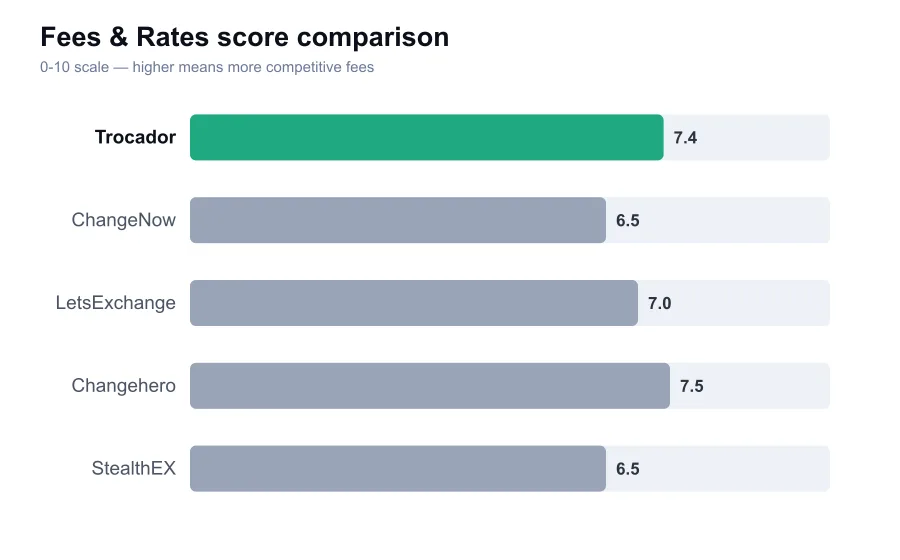
| Fees & Rates | 7.4 | 0.5% service fee, offset by route comparison |
| Transaction Speed | 7.2 | Depends on the chosen exchange partner and chain |
| Security & KYC Policy | 7.5 | Noncustodial aggregator with partner-level risk |
| Reputation & Track Record | 8.1 | Well known among privacy and self-custody users |
| Customer Support | 6.8 | Helpful intermediary, execution stays with partners |
Key Facts
| Fact | Value | Source |
|---|---|---|
| Platform fee | Typically 0.5% | — |
| Service type | Instant exchange aggregator | — |
| Rate types | Fixed and floating, by provider | — |
| Privacy access | Tor-accessible service | — |
| Custody model | No customer trading balance | — |
| Route information | Provider and KYC indicators | — |
Pros & Cons
| Pros | Cons |
|---|---|
| Compares multiple exchange-provider quotes | — |
| Clear 0.5% platform fee | — |
| KYC and rate-type route indicators | — |
| Tor access and Monero-friendly positioning | — |
| Strong recognition in the privacy community | — |
What fee does Trocador charge?
Trocador typically charges a 0.5% service fee on a swap. The selected exchange provider's rate, spread, and network fee are separate parts of the final quote.
Does Trocador require KYC?
Trocador does not normally require conventional account verification, but its partner exchanges may request KYC if a transaction triggers their compliance controls.
What does Trocador's KYC-free route indicator mean?
It indicates that the selected provider is presented as not requiring routine KYC for that route. It is not a guarantee against a later review of a flagged transaction.
Why can two Trocador routes return different amounts?
Each partner has different liquidity, spreads, network costs, confirmation rules, and rate-risk assumptions. Trocador's comparison screen exists to expose those differences before you send.
Can I use Trocador through Tor?
Yes. Trocador provides Tor access, which is one reason it is popular with privacy-focused users. Tor does not remove the selected provider's compliance rules.
Who handles a delayed Trocador swap?
Trocador can assist with support, but the chosen exchange partner performs the conversion and may control the resolution timeline. Save the order details and blockchain transaction hash.
Is Trocador a good option for Monero swaps?
It is one of the more relevant aggregators for Monero users because it supports privacy-oriented routes and lets users compare providers. Check the route's minimum, expected time, and KYC label first.