LetsExchange
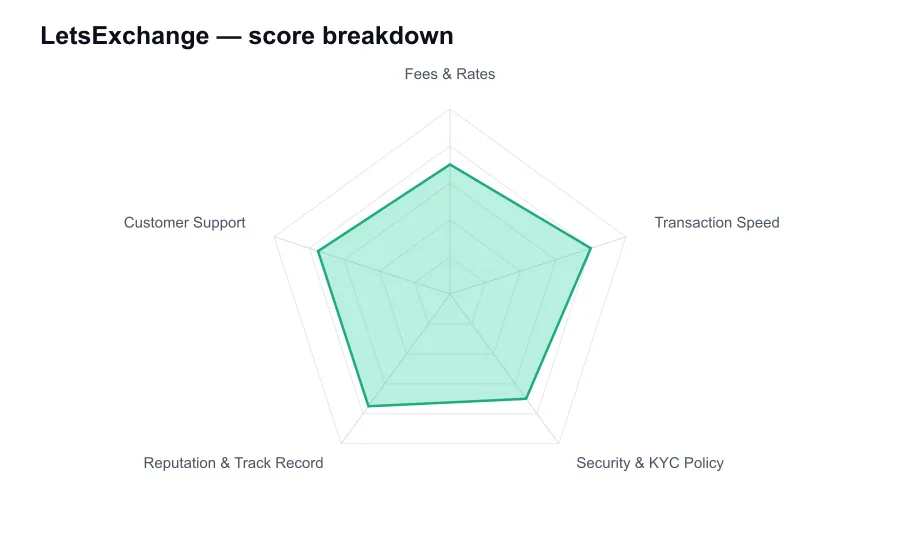
LetsExchange scores 7.4/10 overall in our independent review, measured against every other provider we've compared, strongest on Transaction Speed (8.0/10) and weakest on Security & KYC Policy (7.0/10).
| Best for | Fixed-rate and market-rate swap choices, Broad asset and network coverage, 24/7 customer support, API and widget infrastructure, No routine account registration |
|---|---|
| Not for | No universal flat fee schedule, Final pricing varies by liquidity route, KYC checks can still occur, Not a replacement for a regulated exchange |
What is LetsExchange?
How LetsExchange Works
- Choose the asset, amount, and network you want to send
- Choose the output asset and its receiving network
- Select fixed or market rate where available
- Enter the destination wallet address and review the quote
- Send the requested amount to the generated deposit address
- Use the order tracker until the exchanged funds arrive
KYC
| Requirement | optional |
|---|---|
| Notes | LetsExchange generally supports routine swaps without registration. It may request identity or transaction information where anti-money-laundering and fraud controls require a review. |
Supported Assets
| Coins | 5000 |
|---|---|
| Notable | Bitcoin, Ethereum, Tether, USD Coin, Solana, BNB, TRON, Dogecoin, Polygon, Avalanche |
| Networks | Bitcoin, Ethereum, Tron, Solana, BNB Smart Chain, Polygon, Arbitrum, Optimism, Avalanche, Base |
Limits
| Notes | Minimum and maximum exchange amounts are generated for each pair according to network costs, liquidity, and the selected rate route. |
|---|
How to Use LetsExchange Safely
- Compare final output quotes before creating an order
- Use fixed rate if you need a known minimum output
- Verify the token and network before sending stablecoins
- Test a new route with a small amount first
- Keep your order ID and blockchain transaction hash
- Send output to a self-custody wallet you control
Full Review
LetsExchange is one of the larger instant crypto exchange aggregators. It is built for users who want to convert assets directly between wallets without opening a conventional exchange account or managing an order book. The service sits between a simple swap widget and a liquidity-routing platform, sourcing exchange routes from external partners and presenting users with a single order flow.
That model has made LetsExchange more ambitious than many basic instant exchangers. The platform advertises thousands of supported cryptocurrencies and hundreds of networks, a scale that is useful for holders of tokens beyond Bitcoin and Ether. It also offers both market-rate and fixed-rate options, which gives users a meaningful choice between chasing a potentially better live quote and locking a known output amount.
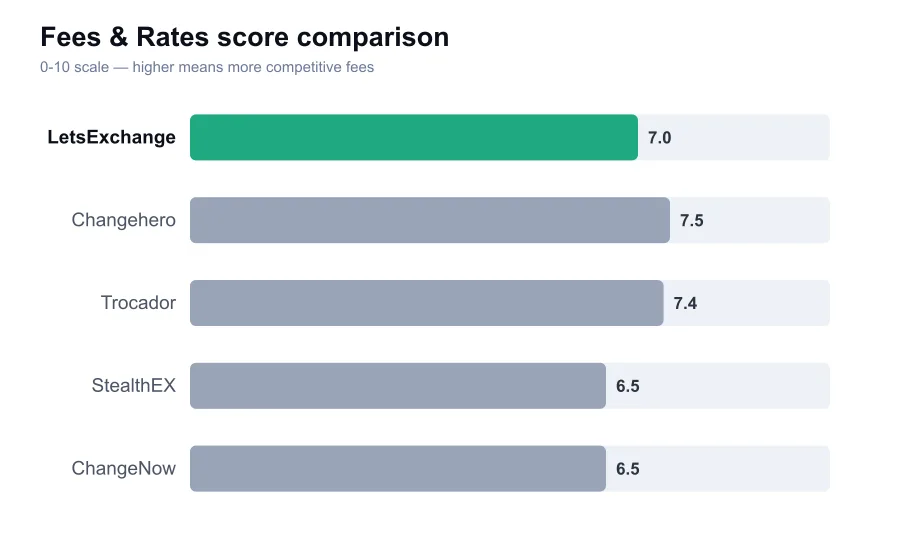
Fees are the main area where users need to read beyond the marketing. LetsExchange does not operate on one universally published percentage that applies to every swap. The rate can include the partner's liquidity pricing, the platform's service margin, and blockchain costs. This is common for an aggregator, but it means the only honest way to judge price is to compare the output shown for your exact order.
In practice, LetsExchange can be competitive, especially on less common pairs where its routing network finds a useful path. It can also be beaten by an exchange with a deep direct market or by another aggregator drawing from a different provider. For mainstream pairs such as BTC to USDT or ETH to USDC, compare a few live quotes. The difference may be modest, but there is no virtue in assuming a large asset list automatically means the best execution.
Its fixed-rate swap option deserves credit. A fixed quote gives the user certainty during a short deposit window, which is valuable during a volatile market move. It is more expensive in some cases because someone must bear price risk. A market-rate order may deliver more if the price improves while the transaction confirms, but it may also deliver less. LetsExchange presents this choice more clearly than services that force users into a single opaque rate model.
Speed is generally good for the category. The platform automates order creation and routes liquidity rather than asking users to wait for manual approval. Yet no aggregator can escape blockchain reality. Bitcoin deposits need confirmations, Ethereum can slow down during high gas periods, and cross-chain asset availability can be affected by partner maintenance. A fast user interface should not be mistaken for guaranteed fast settlement.
LetsExchange is non-custodial in the practical sense that it does not provide a permanent customer trading balance for routine swaps. Funds are sent from one wallet and delivered to another. That reduces some familiar centralized exchange risks, such as account takeover and a platform holding your portfolio for months. It does not eliminate transaction risk, because the provider and its partners still handle value while a swap is being executed.
The KYC position is similarly more nuanced than promotional shorthand suggests. LetsExchange generally permits users to create ordinary crypto swap orders without registration or routine identity verification. It can request information where anti-money-laundering or fraud controls require review. This is a sensible legal safeguard, but users should understand that a no-account exchange does not promise that every incoming transfer will be processed anonymously and without interruption.
On security, LetsExchange has a better public profile than the smallest swap sites. It has been operating since 2019, has maintained partnerships and public product integrations, and has a visible support presence. Still, it is not equivalent to a heavily regulated custodian with audited statements and statutory customer safeguards. The platform's broad partner network is useful, but each route adds another operational dependency that the user cannot inspect directly.
Its reputation is solid within the instant-exchange niche, though it is not spotless in the way no exchange service is spotless. Public review sites contain positive comments about successful fast swaps alongside complaints about delayed transactions, changed output during floating-rate orders, and compliance holds. That pattern is normal for the category. The fair question is whether the company provides identifiable support channels and enough history to make resolution plausible. LetsExchange does better here than a newly launched anonymous competitor.
Customer support is one of its relative strengths. LetsExchange offers 24/7 chat and email support, and its help materials cover common issues such as incorrect deposits, confirmation delays, and order tracking. That does not guarantee a happy result where a user has sent an unsupported asset, but it gives customers more to work with than a service that hides behind an unmonitored contact form.
The huge asset list requires restraint. A listing does not make every token equally liquid, and some network versions may be temporarily unavailable. Stablecoin users should verify whether they are swapping USDT or USDC on Ethereum, Tron, Solana, Polygon, Arbitrum, or another supported chain. The wrong network can turn a quick exchange into a recovery request, and recovery is never guaranteed.
LetsExchange also offers an API and exchange widget for businesses, which helps explain why it has a larger presence than a basic retail-only swap page. That is useful for wallet providers, affiliate sites, and applications looking to offer exchanges without building liquidity connections themselves. Retail customers do not need those tools, but the business infrastructure indicates a platform trying to be more than a one-page conversion form.
For users, the sensible approach is simple. Use a fixed-rate order if receiving a minimum known amount matters more than marginal savings. Use a market-rate order only if you accept price movement while the deposit confirms. For a large transfer, test the wallet path first, check the final quote against alternatives, and avoid sending funds from an exchange account that may delay withdrawals or omit required memo information.
LetsExchange is among the better choices in the instant-exchange category, though the category itself has built-in limits. Its asset coverage, rate options, and support are stronger than what smaller providers offer. Its pricing is not transparent enough to win automatically, and its non-custodial label should not be read as risk-free. I would use it for a well-checked wallet-to-wallet swap, especially where its route gives a strong quote. For major capital or fiat trading, a regulated exchange with direct market access remains the better home.
Criteria Scores
| Criterion | Score | Note |
|---|---|---|
| Fees & Rates | 7.0 | Quote-based pricing, with fixed and market-rate options |
| Transaction Speed | 8.0 | Automated routing, subject to chain confirmations |
| Security & KYC Policy | 7.0 | Non-custodial swap model, with possible AML reviews |
| Reputation & Track Record | 7.5 | Active since 2019 with a stronger public presence |
| Customer Support | 7.5 | 24/7 chat and email support with help documentation |
Key Facts
Pros & Cons
| Pros | Cons |
|---|---|
| Fixed-rate and market-rate swap choices | — |
| Broad asset and network coverage | — |
| 24/7 customer support | — |
| API and widget infrastructure | — |
| No routine account registration | — |
Does LetsExchange charge one fixed fee?
No. LetsExchange uses quote-based pricing that can include liquidity-provider pricing, platform margin, and network costs. Compare the final received amount for the exact pair you want.
Does LetsExchange require KYC?
Routine swaps generally do not require a conventional account or standard KYC. LetsExchange can request information if its compliance or anti-fraud systems flag an order.
What is the difference between fixed and market rates?
A fixed-rate order locks a quoted output for a limited deposit window. A market-rate order follows the live rate during processing, so the final amount can rise or fall.
Why is my LetsExchange order delayed?
Delays commonly result from incoming blockchain confirmations, congestion, inadequate sender fees, partner maintenance, or a compliance review. Check the order tracker and transaction hash first.
Does LetsExchange support business integrations?
Yes. LetsExchange offers an API and exchange widget, allowing wallets, websites, and other businesses to integrate crypto exchange functionality.
Can I swap USDT across different chains?
Only if the chosen route explicitly supports the relevant networks. Confirm whether the order uses Ethereum, Tron, Solana, Polygon, Arbitrum, or another chain before depositing.
Is LetsExchange a wallet?
No. LetsExchange is a swap service. The output should be sent to a wallet you control, and it should not be treated as a long-term custody platform.