StealthEX
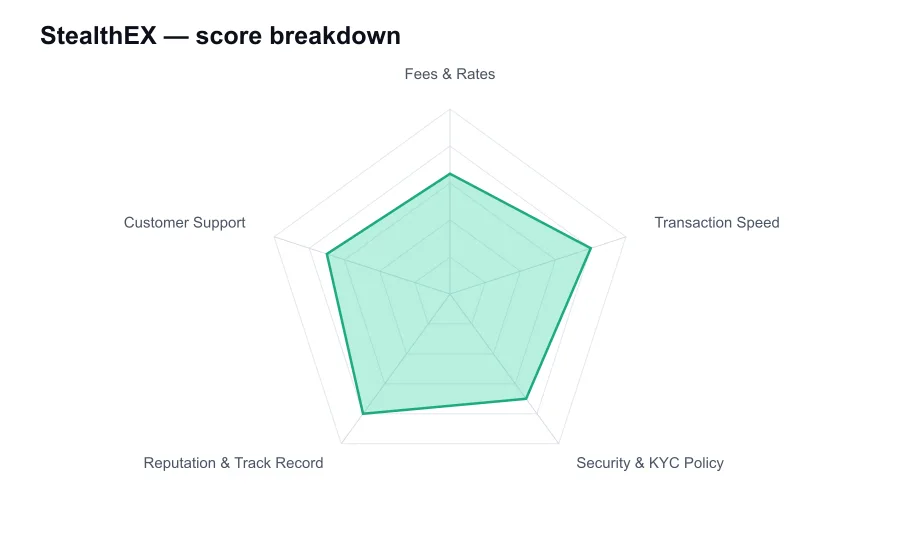
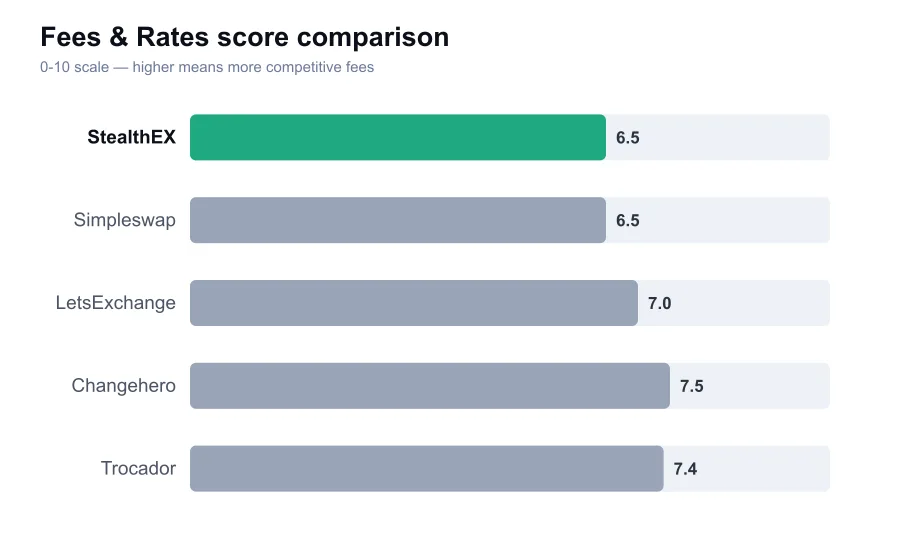
StealthEX scores 7.3/10 overall in our independent review, measured against every other provider we've compared, strongest on Transaction Speed (8.0/10) and weakest on Fees & Rates (6.5/10).
| Best for | Established instant-exchange brand, Large asset selection, Fixed and floating exchange rates, No routine account registration, Useful for direct wallet conversions |
|---|---|
| Not for | Costs are quote-based rather than fully itemized, Compliance checks can interrupt a swap, Small-cap token routes may have weaker liquidity |
What is StealthEX?
How StealthEX Works
- Choose the input and output cryptocurrencies
- Select a floating or fixed rate where available
- Enter the receiving wallet address
- Send the requested asset to the generated deposit address
- Wait for blockchain confirmations and payout
KYC
| Requirement | optional |
|---|---|
| Notes | StealthEX does not generally require account registration for routine use, but may request KYC or source-of-funds material after automated AML risk screening. |
Supported Assets
| Notable | Bitcoin, Ethereum, Tether, USD Coin, Monero, XRP, Stellar, Solana, Dogecoin |
|---|---|
| Networks | Bitcoin, Ethereum, Tron, BNB Smart Chain, Solana, Polygon |
How to Use StealthEX Safely
- Check whether the order is fixed-rate or floating-rate
- Use the exact token network shown in the deposit instructions
- Include any required memo or destination tag
- Start with a small test amount for an unfamiliar route
- Keep the order ID and transaction hash until payout arrives
Full Review
StealthEX is a non-custodial instant exchange service built around a simple proposition: swap crypto without creating a conventional exchange account. It is a direct competitor to SimpleSwap, ChangeNOW, Quickex, and LetsExchange. The service has become particularly visible among users seeking wallet-to-wallet conversions and among people who prefer avoiding a standing custodial account. Its strengths are breadth, convenience, and a relatively mature product. Its limitations are the same structural limitations faced by every intermediary-based instant exchanger.
The basic flow is uncomplicated. Select the coin you are sending, select the one you want back, enter a destination address, and transfer the input asset to the generated address. StealthEX then processes the order through its liquidity sources and sends the output to the wallet you nominated. There is no trading terminal, no charting suite, and no reason to use it for repeated tactical trades. It is built for conversion, not price discovery.
StealthEX has promoted access to a large number of assets, including major coins and a long tail of smaller tokens. Breadth is helpful, especially when a user wants to exchange an asset that large centralized exchanges do not list in the same place. But it can also create false confidence. A listed pair does not automatically mean deep liquidity, quick settlement, or an attractive rate. Less liquid tokens may involve wider spreads, minimums, or a longer route through external partners.
Fees are embedded in the displayed exchange result rather than expressed as one simple platform percentage that applies to every pair. The provider has historically described its service fee as being included in the rate, while blockchain network fees and liquidity conditions also influence the final result. This is common, but it means a shopper must compare the payout amount rather than rely on broad claims about low fees. On a small transaction, network costs can matter more than the service margin. On a large transaction, the spread matters more.
The fixed-rate function is a meaningful feature, especially for volatile assets. It gives a clearer expected result than a floating quote, provided the customer sends the required amount within the order window and the selected pair remains available. Floating-rate transactions may initially look more attractive, but they expose the user to price movement during confirmations and execution. I prefer fixed rate for an important conversion. If the trade is speculative and the amount is small, floating can be reasonable, but it should be a conscious choice.
StealthEX is generally fast on standard liquid routes. Once the deposit arrives and satisfies the confirmation requirement, many transactions are completed in a short period. Still, users should resist treating the advertised exchange time as a promise. Bitcoin confirmation times vary, Ethereum gas conditions can delay transfers, and partner liquidity is not under a customer's control. A fast interface is not the same thing as instant settlement.
Some assets add their own wrinkles. XRP, XLM, EOS-style accounts, and other assets that use destination tags, memos, or chain-specific identifiers require careful attention. If the required memo is omitted, recovery may depend on manual support and may not be simple. The same applies to wrapped tokens and stablecoins on multiple networks. StealthEX can make an exchange feel simple, but the underlying transfer rules remain technical and unforgiving.
From a security perspective, StealthEX has a useful advantage over account-based exchanges: users do not need to leave a trading balance sitting on the platform. That reduces the risk tied to an abandoned account, reused password, or compromised exchange login. Yet the service still receives funds during execution. This is not a decentralized exchange where a smart contract settles transparently from your own wallet. You are relying on StealthEX, its operational controls, and its liquidity providers until the outgoing transaction is complete.
The brand's privacy-oriented name should not be read as a guarantee of immunity from compliance checks. StealthEX states that it uses an automated risk-management approach and can request KYC information for transactions that raise anti-money-laundering concerns. That is a rational business practice, but customers need to understand it before sending funds. A no-registration checkout does not equal an irrevocable right to complete every transfer without identification.
Reputation is one of StealthEX's better points. It has operated for years, has a visible public identity, publishes support material, and has accumulated meaningful user feedback. That is more reassuring than a new site with no history. The feedback is not flawless. Complaints about delayed orders, changing floating rates, and verification requests exist, as they do for its peers. The relevant question is whether the company has enough track record to be judged. It does, though it remains far from the disclosure standards of a major regulated exchange.
Support is a practical differentiator here. StealthEX maintains site support channels and documentation that covers common issues such as pending deposits, missing IDs, and order tracking. For a routine exchange, that may be all anyone needs. During a problem transaction, response speed and the ability to explain the actual status matter far more. The service is better positioned than a faceless swap widget, but users should still expect a support process rather than an instant human solution for a blockchain or compliance problem.
I would especially avoid sending an unusual token or a six-figure amount as a first order. Test the route. Check the exact network. Confirm whether the estimate is fixed or floating. Those sound like elementary instructions, yet most serious complaints in this sector begin with one of those details. StealthEX is much easier to use safely if you approach it as a transfer operation with irreversible steps, rather than as a magic exchange button.
Against SimpleSwap, StealthEX is broadly comparable, with both offering a mature instant-swap experience and a choice of quote types. Against Quickex, it has a stronger public profile and broader recognition. Against a major centralized exchange, it loses on explicit market structure, trading tools, and potentially on costs for frequent users. That is not an indictment. It defines the audience. StealthEX is for someone who values a low-friction conversion more than exchange-style control.
My final assessment is positive but disciplined. StealthEX is among the more credible instant exchangers, and it has enough history to deserve consideration for normal wallet-to-wallet swaps. It is not the cheapest route by default, nor is it a way to bypass every compliance requirement. Compare quotes, use fixed rate when certainty is valuable, and do a small test for unfamiliar chains. Used that way, it is a practical service with a better standing than most of the smaller names in this field.
Criteria Scores
| Criterion | Score | Note |
|---|---|---|
| Fees & Rates | 6.5 | Service costs are embedded in quotes and vary by pair and network. |
| Transaction Speed | 8.0 | Liquid swaps are usually prompt after deposit confirmation. |
| Security & KYC Policy | 7.0 | No persistent custody, though flagged orders can require KYC. |
| Reputation & Track Record | 8.0 | Longer public track record than many small swap providers. |
| Customer Support | 7.0 | Documentation and support channels cover common order issues. |
Key Facts
Pros & Cons
| Pros | Cons |
|---|---|
| Established instant-exchange brand | — |
| Large asset selection | — |
| Fixed and floating exchange rates | — |
| No routine account registration | — |
| Useful for direct wallet conversions | — |
Does StealthEX hold a permanent customer balance?
StealthEX is designed for direct exchanges rather than a standing trading balance. Funds are still transferred into the exchange process while an order is being completed.
Does StealthEX require KYC?
Routine orders may be started without account registration, but StealthEX can request verification if automated risk checks identify a transaction for review.
Can I use a fixed rate on StealthEX?
StealthEX offers fixed-rate and floating-rate options for supported pairs. A fixed quote depends on sending the required deposit correctly within the stated order conditions.
Why is my StealthEX transaction taking longer than expected?
Delays can come from deposit confirmations, blockchain congestion, liquidity routing, or compliance review. Check the order status and the input transaction on a block explorer.
Do XRP and XLM swaps need a tag or memo?
They can. Follow the generated deposit instructions exactly. Missing destination tags or memos can require manual recovery and may delay or prevent crediting.
Is StealthEX a decentralized exchange?
No. It is an instant exchange intermediary that routes swaps through its systems and liquidity providers. It is not an on-chain order-book or AMM decentralized exchange.