Exolix
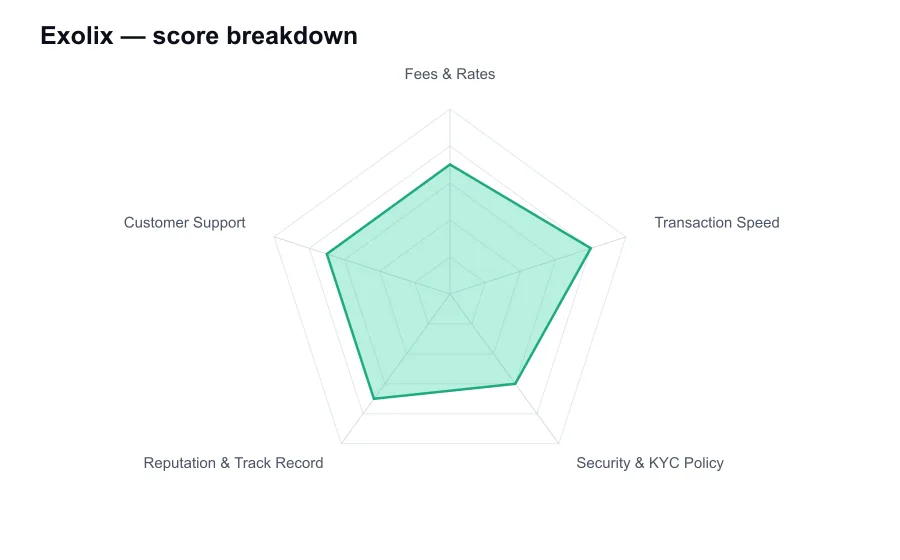
Exolix scores 7.0/10 overall in our independent review, measured against every other provider we've compared, strongest on Transaction Speed (8.0/10) and weakest on Security & KYC Policy (6.0/10).
| Best for | Operating since 2018, Broad selection of crypto conversion routes, Fixed-rate and floating-rate options, No standing custodial account balance |
|---|---|
| Not for | Fees are embedded in quoted exchange rates, AML screening can pause a transaction, Thin-token routes may have weak liquidity |
What is Exolix?
How Exolix Works
- Select the asset, network and amount to send
- Choose the asset and destination wallet to receive
- Select fixed or floating rate if both are available
- Send the requested amount to the generated address
- Follow the order with the exchange ID until payout
KYC
| Requirement | optional |
|---|---|
| Notes | Exolix generally permits routine swaps without opening a standard verified account. Its AML procedures can trigger requests for information or documents on flagged transactions. |
Supported Assets
| Notable | Bitcoin, Ethereum, Tether, USD Coin, BNB, Solana, Litecoin, Dogecoin |
|---|---|
| Networks | Bitcoin, Ethereum, BNB Smart Chain, Polygon, Solana, TRON |
How to Use Exolix Safely
- Use fixed-rate mode for a time-sensitive payout
- Confirm token contract and network before depositing
- Run a small test for a new asset or network route
- Record the exchange ID and blockchain transaction hash
- Compare the displayed payout with another live provider
Full Review
Exolix is a non-custodial instant crypto exchange with a much clearer identity than most small swap services. It focuses on wallet-to-wallet conversions, offers a large selection of crypto routes and has been active long enough to develop a recognizable place alongside ChangeNOW, SimpleSwap and EasyBit. It is not an order-book exchange, and users should judge it as a conversion service rather than as a place to trade actively.
The product is built for speed and low friction. You select a pair, choose a floating or fixed rate where available, submit a receiving address and fund the generated deposit address. Exolix processes the exchange and sends the output directly to your wallet. For users already holding assets in self-custody, this is often much simpler than depositing to a centralized exchange, executing a trade and withdrawing again.
Exolix supports a broad range of assets and routes, including established coins, stablecoins and many smaller tokens. That range is useful, especially when a wallet holds an asset that major exchanges do not list. It also creates a trap: broad support does not mean every route has deep liquidity. A token may be technically available while still producing an unattractive quote or a long processing time.
The provider's fees are built into the exchange quote rather than presented as a tidy trading commission. Exolix says the displayed amount accounts for the relevant rate and costs, but that does not make every quote cheap. The correct test is simple. Compare the amount you will receive against a competing instant exchange and, for large liquid pairs, against the cost of using a deep centralized exchange yourself.
For common routes, Exolix can be competitive. The service is particularly convenient for users who value a single all-in number over manually calculating trading, withdrawal and network charges. Fixed-rate swaps are often worth selecting when price certainty matters. They reduce the risk of a sharp move during blockchain confirmation, though the customer has to send the exact amount within the stated time conditions.
Floating-rate swaps can yield a better outcome if the market moves favorably, but they leave the final payout uncertain. This is not hidden behavior. It is the core trade-off of the rate mode. People often complain after treating a floating estimate as a promise, so read the order screen. If you are swapping into stablecoins to meet a precise obligation, fixed-rate execution is generally the more sensible choice.
Speed is one of Exolix's stronger points. Routine exchanges on fast and liquid networks can complete promptly once the incoming deposit has enough confirmations. Exolix cannot accelerate Bitcoin blocks or rescue an Ethereum transaction sent with an inadequate gas fee, but it usually removes the slow account-review and withdrawal-queue steps associated with conventional exchanges.
There are practical limits to that speed. Large orders can require liquidity sourcing, cross-chain token routes can involve more operational steps, and blockchain congestion can dominate the entire timeline. A user who needs coins in ten minutes should not rely on any instant exchanger unless the route has been tested before. The service is fast by exchange standards, not a guarantee against blockchain reality.
Exolix is commonly described as a no-KYC exchange, which is accurate only in the everyday sense that users can normally swap without opening an identity-verified account. Its compliance policies still matter. The service can flag activity, request information and pause a transaction while it assesses anti-money-laundering risk. That is an important caveat for privacy-minded users and for anyone moving funds with a complicated history.
Its non-custodial structure is a real security benefit. You do not leave a standing account balance exposed to password theft, withdrawal whitelists failing or an exchange becoming insolvent. The provider holds funds only while converting them. Yet temporary custody is still custody. Double-checking the output address and the chosen network remains entirely the user's responsibility, and a wrong-chain transfer may be unrecoverable.
Exolix has a better public track record than a newly launched anonymous swap page. It has operated since 2018, maintains product documentation and has a visible presence in the instant-exchange market. That earns it a respectable reputation score. It is still a private service with less external oversight and fewer public financial details than regulated centralized exchanges, so I would not extrapolate that record into unlimited trust.
Support is available around the clock through the provider's channels, and the exchange ID gives users something concrete to cite if a transaction stalls. That matters. Support can usually explain whether a deposit is still confirming, whether a payout has been sent or whether a review is underway. It cannot always make a delayed blockchain move faster, and it cannot necessarily reverse a completed payout to an incorrect address.
Exolix is strongest for self-custody users making routine conversions across supported networks. It is weaker for professional traders, people who need an audit trail from a regulated exchange and customers who cannot accept the possibility of an AML hold. A large transaction deserves a test order and quote comparison, even if you have used Exolix successfully in the past.
I rate Exolix as one of the more credible options in the instant-exchange category. It combines a broad offering, practical fixed-rate functionality and decent customer accessibility. The main compromise is the same one found across this business model: pricing is quote-driven and compliance can interrupt the seamless experience. Use it for convenient swaps, not as a replacement for careful execution or cold storage.
Criteria Scores
| Criterion | Score | Note |
|---|---|---|
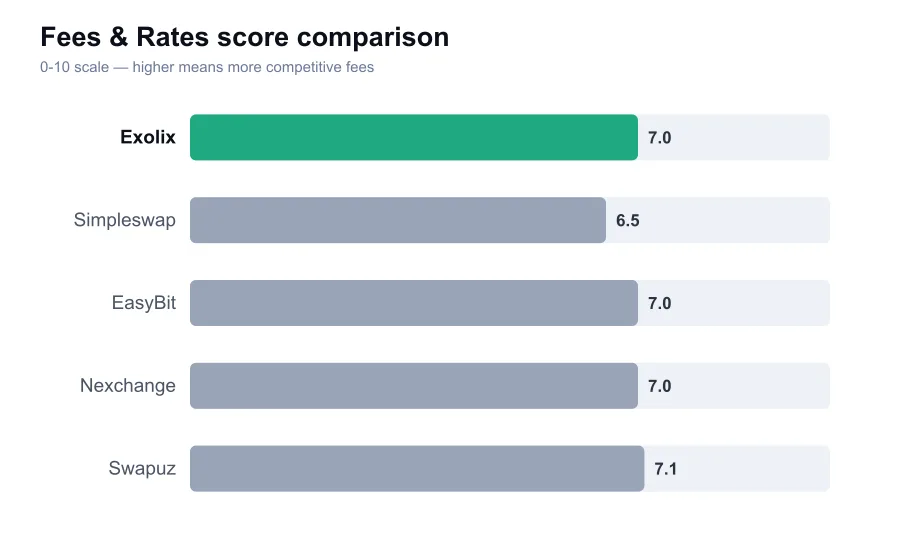
| Fees & Rates | 7.0 | All-in quotes are competitive on many liquid routes |
| Transaction Speed | 8.0 | Fast processing after deposit confirmations |
| Security & KYC Policy | 6.0 | Non-custodial model, with possible AML holds |
| Reputation & Track Record | 7.0 | Operating since 2018 with a visible market presence |
| Customer Support | 7.0 | 24/7 assistance and exchange ID tracking |
Key Facts
Pros & Cons
| Pros | Cons |
|---|---|
| Operating since 2018 | — |
| Broad selection of crypto conversion routes | — |
| Fixed-rate and floating-rate options | — |
| No standing custodial account balance | — |
How long has Exolix been operating?
Exolix has operated since 2018, which gives it a longer visible record than many recently launched instant exchange services.
Does Exolix require KYC?
Routine exchanges can generally be made without standard account verification. Exolix can still request information or documents where AML systems flag a transaction.
What is the difference between fixed and floating rates on Exolix?
A fixed rate aims to lock the quoted payout if deposit conditions are met. A floating rate changes with the market while your transfer confirms.
Why is my Exolix transaction still pending?
The deposit may still need blockchain confirmations, the route may need liquidity sourcing, or the transaction may be undergoing a compliance review.
Can I use Exolix for obscure tokens?
Many smaller assets are supported, but availability does not guarantee deep liquidity. Review the final quote and test an unfamiliar route with a small amount.
What should I send to Exolix support?
Send the exchange ID, deposit transaction hash, sent amount, source network and receiving address. Those details let support locate the order.