Swapuz
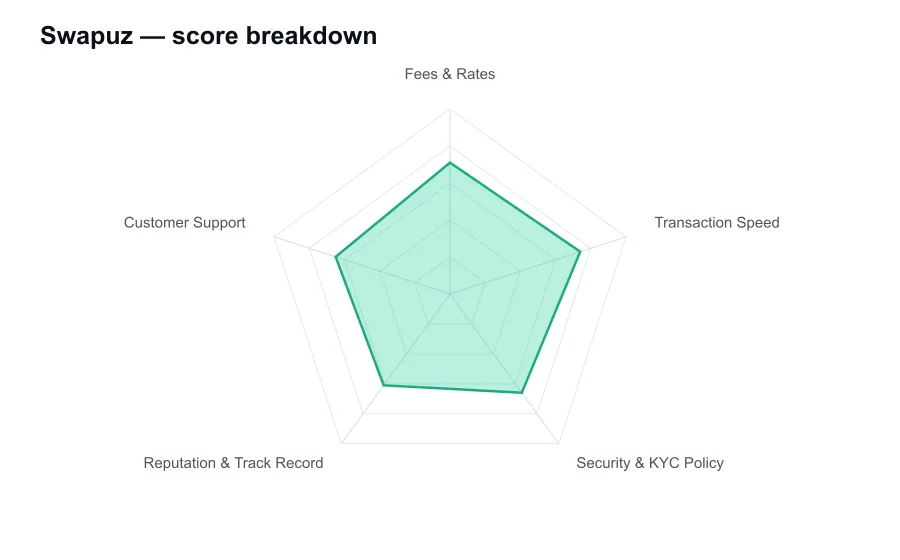
Swapuz scores 6.8/10 overall in our independent review, measured against every other provider we've compared, strongest on Transaction Speed (7.4/10) and weakest on Reputation & Track Record (6.1/10).
| Best for | No routine account registration for ordinary swaps, Fixed-rate and floating-rate routes, Broad asset and network selection, Useful quote comparison for one-off conversions |
|---|---|
| Not for | Final cost is partly embedded in the quoted rate, KYC may be requested on flagged transactions, Less public operating history than major exchanges |
What is Swapuz?
How Swapuz Works
- Choose the asset and network you are sending
- Select the asset and network you want to receive
- Enter and verify your destination wallet address
- Review the fixed or floating quote and create the order
- Send the exact deposit to the generated address
- Track confirmations and receive the payout
KYC
| Requirement | optional |
|---|---|
| Notes | No routine signup is required for ordinary swaps, but Swapuz or a liquidity partner may request verification for transactions that trigger compliance review. |
Supported Assets
| Notable | Bitcoin, Ethereum, Tether, USD Coin, Litecoin, Solana, BNB |
|---|---|
| Networks | Bitcoin, Ethereum, Tron, BNB Smart Chain, Solana |
How to Use Swapuz Safely
- Compare the final received amount with at least one rival quote
- Send a small test amount before a large first-time swap
- Match the token network exactly on both sides
- Save the order ID, deposit address, and transaction hash
- Never send funds after a fixed-rate deposit window expires
Full Review
Swapuz is a noncustodial instant exchange service aimed at people who want to convert one cryptoasset into another without opening a conventional exchange account. It sits between a basic swap widget and an exchange aggregator. The service presents offers from liquidity partners, then lets the customer choose a floating or fixed-rate route. That makes it a practical tool for one-off conversions, although it is not a serious replacement for a deep spot market.
The appeal is obvious. There is no trading screen full of order books, no identity form at the beginning of a small swap, and no need to leave coins on a centralized platform. Pick a pair, enter a receiving address, send the deposit, and wait for the service's partner to complete the trade. For a user moving from BTC into ETH or USDT, that workflow is far less intimidating than using a large exchange.
Swapuz markets a wide selection of assets and networks, including major coins alongside the long tail of tokens that centralized exchanges regularly ignore. That breadth is useful, but it has a catch. A listed asset is not the same thing as deep, reliable liquidity. Small tokens can produce a rate that changes sharply before the trade is completed, or a route may disappear if the underlying provider cannot fill it.
Pricing is where Swapuz needs a skeptical reading. The service often promotes competitive rates and no registration, but a customer should not mistake that for fee-free trading. The cost can be embedded in the quoted exchange rate, network fee, and liquidity-provider spread. This is common in instant exchanges. The only rate that matters is the amount of the destination coin shown before you send, compared with a live reference price from a liquid market.
For mainstream pairs, Swapuz can be reasonably priced if you compare quotes. It is especially useful when its aggregator finds a better route than a single-provider competitor. Still, it rarely beats a low-fee spot trade for someone already verified on Kraken, Coinbase Advanced, or Binance. An experienced trader using a limit order can often pay less, particularly on large BTC, ETH, or stablecoin conversions.
The fixed-rate option is one of Swapuz's better features. It gives the user more certainty about the amount they should receive, subject to the deposit arriving within the stated window and the transaction meeting the service's conditions. In a volatile market, that can be worth paying a slightly worse quote for. Floating-rate swaps can be cheaper at the moment of creation, but the final amount may move with the market while confirmations arrive.
Speed is decent rather than miraculous. A simple transaction on a fast network can complete in minutes after the deposit is confirmed. Bitcoin deposits naturally take longer, and swaps involving several confirmations, congested Ethereum blocks, or a thin liquidity route can stretch much further. Anyone promising that an onchain exchange is instant is selling a fantasy. The blockchain and the liquidity partner both have to do their part.
Swapuz does not take custody in the way a conventional exchange does, which limits the risk of leaving a balance exposed to an exchange failure. That is a meaningful advantage. Yet a noncustodial label does not eliminate counterparty risk. You still send funds to an address controlled by the swap process, and the service or its provider must deliver the other side. Treat each swap as a transfer that cannot be reversed.
The KYC position is also more nuanced than the promotional language suggests. Swapuz can be used without routine account registration, but it may request verification where a transaction triggers compliance checks or a partner flags the source of funds. That is normal for this category. Users who need a guaranteed no-document route should not assume any instant exchanger can provide one for every coin, amount, and transaction history.
The service gives users a transaction page and status tracking, which is essential. Save the order ID, deposit address, quoted amount, transaction hash, and screenshots before sending funds. If a transfer stalls, those details are what support needs to identify it. A wallet's transaction ID alone is often not enough if the issue concerns an incorrect memo, a delayed partner, or a rate recalculation.
Swapuz's reputation is still developing. It has a recognizable presence among smaller instant exchange brands, but it does not have the long operating record, public company disclosures, or independent security history of the largest custodial venues. That does not make it unsafe by default. It does mean I would test it with a modest amount before trusting it with a large conversion.
Support is available through the website's contact channels and live chat, and it tends to matter most when a swap goes wrong. Routine swaps need little human help. Difficult cases can involve blockchain confirmations, wallet tags, compliance reviews, or liquidity-provider delays, none of which a support agent can always solve quickly. The quality test is whether the team gives a specific status and transaction explanation rather than canned reassurance.
There are a few practical traps. Always select the correct network, especially for USDT and USDC. Do not send tokens from an exchange until you have checked whether its withdrawal system needs a memo or tag. And do not use a fixed-rate order after its deposit window has expired. These are user errors that can turn a quick swap into a manual recovery case.
My view is that Swapuz is a useful convenience service, not a place to build a trading routine around. It makes sense for a straightforward, moderately sized swap when its quote wins a comparison and you value privacy from routine account creation. For large orders, obscure assets, or funds whose provenance may invite review, use a venue with deeper liquidity, clearer institutional support, and a stronger public track record.
Criteria Scores
| Criterion | Score | Note |
|---|---|---|
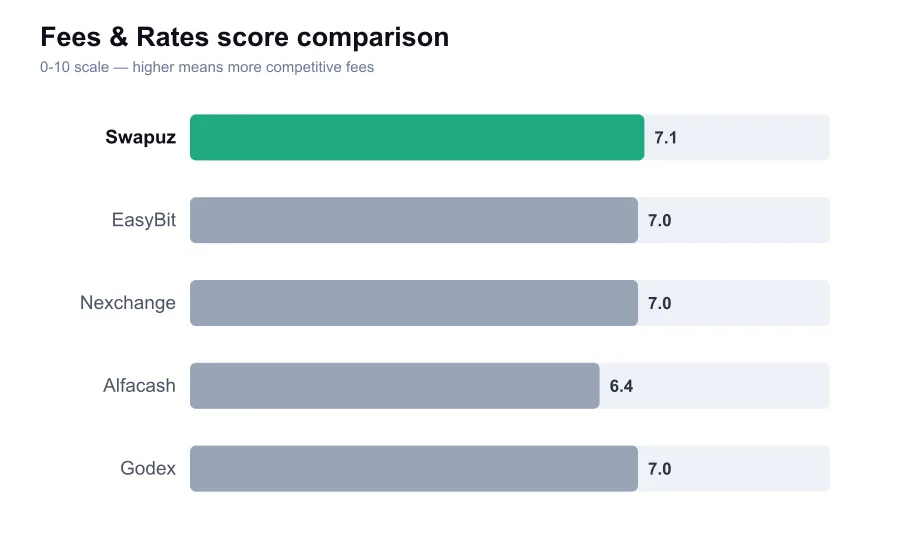
| Fees & Rates | 7.1 | Competitive quoted rates, but spreads matter |
| Transaction Speed | 7.4 | Fast on liquid pairs after confirmations |
| Security & KYC Policy | 6.6 | Noncustodial flow, KYC can still be triggered |
| Reputation & Track Record | 6.1 | Established niche brand, limited long-term record |
| Customer Support | 6.5 | Order tracking and web support for exceptions |
Key Facts
| Fact | Value | Source |
|---|---|---|
| Service type | Noncustodial instant exchange | — |
| Rate options | Fixed and floating | — |
| Account model | No routine account registration | — |
| Custody model | Swap-based, no user balance account | — |
| Settlement | Onchain deposit and payout | — |
Pros & Cons
| Pros | Cons |
|---|---|
| No routine account registration for ordinary swaps | — |
| Fixed-rate and floating-rate routes | — |
| Broad asset and network selection | — |
| Useful quote comparison for one-off conversions | — |
Does Swapuz require an account?
Routine swaps can generally be created without opening a conventional trading account. Keep the order ID and transaction hash, since those are needed if support must trace a swap.
Can Swapuz ask for KYC after I send funds?
Yes. Like other instant exchangers, Swapuz can request verification if a transaction or its source is flagged by compliance controls or a liquidity partner.
What is the difference between fixed and floating rates on Swapuz?
A fixed-rate route aims to deliver the displayed amount if funds arrive within the stated deposit window. A floating route settles at the market rate during processing, so the received amount can change.
Why is my Swapuz transaction taking longer than expected?
The most common causes are slow deposit confirmations, Bitcoin confirmation requirements, network congestion, or a liquidity provider taking longer to fill the order.
Can I send USDT to any address shown by Swapuz?
No. USDT exists on multiple networks. Send only on the network shown in the order, such as Ethereum, Tron, or BNB Smart Chain, and check whether your sending wallet requires a memo.
Is Swapuz cheaper than trading on a centralized exchange?
Not consistently. Swapuz may offer a strong all-in quote for a simple swap, but an already verified user placing a limit order on a low-fee spot exchange can often pay less.