Nexchange
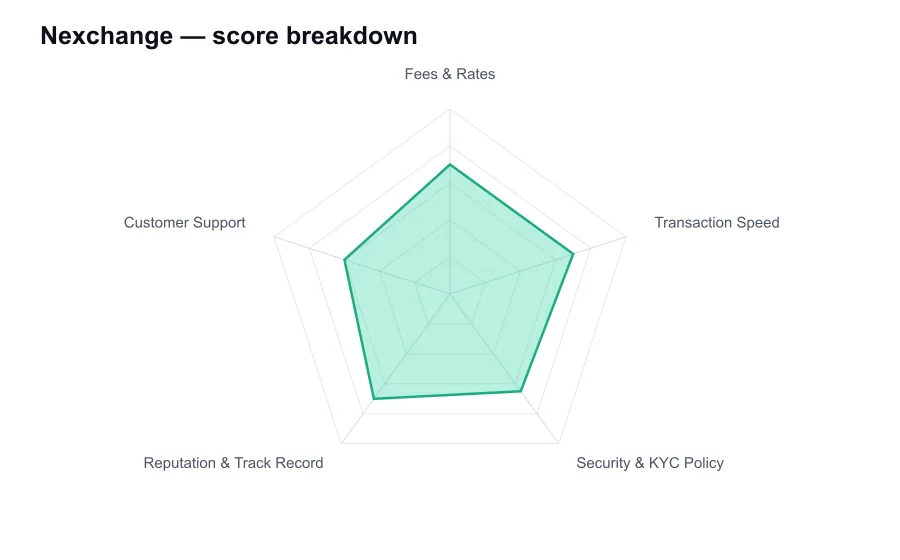
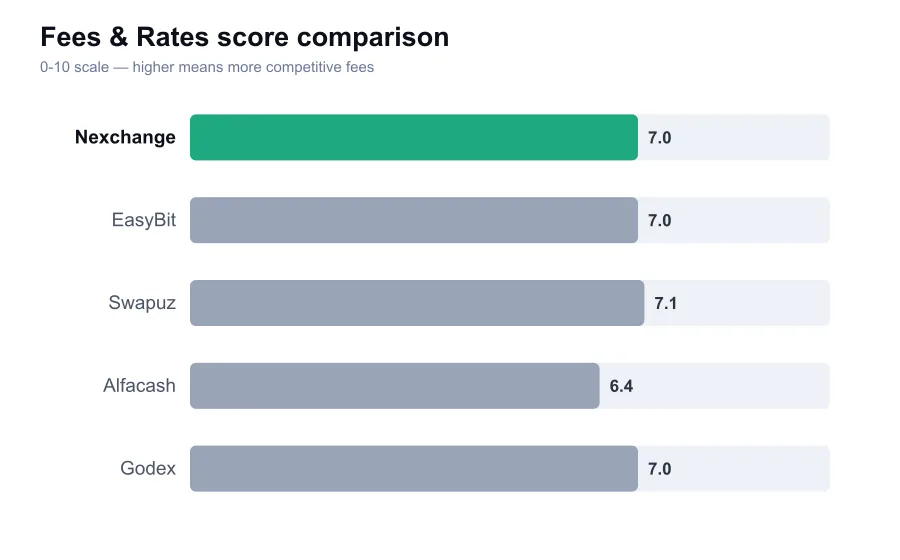
Nexchange scores 6.8/10 overall in our independent review, measured against every other provider we've compared, strongest on Fees & Rates (7.0/10) and weakest on Customer Support (6.0/10).
| Best for | Clear instant-exchange focus, Historically published 0.5% service fee, API capability for developers and partners, More established than many small swap sites |
|---|---|
| Not for | 0.5% can be costly for active traders, Network fees and spread still affect payouts, Funds remain under provider control during processing, Not designed for high-touch retail support |
What is Nexchange?
How Nexchange Works
- Select the crypto pair and amount
- Enter the destination wallet address
- Review the quoted payout and applicable network costs
- Send the deposit asset to the generated address
- Wait for required confirmations and conversion
- Receive the output asset in your destination wallet
KYC
| Requirement | optional |
|---|---|
| Notes | Nexchange has supported a no-standard-account exchange flow, but compliance checks can still be applied to flagged transactions. |
How to Use Nexchange Safely
- Compare the final payout with a live competing quote
- Send a test transaction before a large conversion
- Confirm the destination network and address carefully
- Save the deposit hash and order reference
- Move received coins to self-custody if appropriate
Full Review
Nexchange is an instant cryptocurrency exchange service with a stronger product identity than many anonymous-looking swap sites. It is built around a simple exchange flow and an API that other businesses can use to offer crypto conversions. That business-to-business angle matters. Nexchange is not trying to be a full retail brokerage with a giant social media presence, staking menus, or an elaborate trading terminal. It is a utility service for exchanging one asset for another.
That narrower focus has benefits. The interface is usually easier to understand than a conventional exchange order book, and users do not need to learn limit orders, maker fees, or wallet transfers between multiple account sections. Pick a pair, enter an amount, supply a payout address, and fund the order. For users who simply want to convert Bitcoin into Ether, Litecoin, or another supported asset, that is a sensible model.
Nexchange has operated for years and is one of the more recognisable names among API-led instant exchange providers. It does not have the public brand strength of Coinbase or Kraken, but it has a more established operating record than obscure one-page swap sites. The service has also long been associated with programmatic exchange functionality, which suggests a more serious technical orientation than a consumer-only operation built around marketing claims.
Its fee structure is broadly more understandable than that of many lightly documented competitors. Nexchange has historically described a 0.5 percent service fee for exchanges, with network fees and the market rate affecting the final result. Users still need to inspect the quote. A stated percentage does not remove spread risk, especially in smaller coins or during sharp price movement. But having a clear baseline is far better than asking customers to infer costs from the result after a transaction settles.
A 0.5 percent exchange fee is not the cheapest route for every trade. On a liquid Bitcoin or Ether pair, an experienced trader can often get a lower direct trading cost on Kraken, Coinbase Advanced, Binance where available, or another large exchange. That comparison misses the point for some customers, though. Nexchange charges for a simpler conversion and less account friction. For occasional swaps, the difference can be acceptable. For repeated or large-volume trading, it adds up quickly.
The most important fee check is the final receive amount. Network fees may be significant during periods of Bitcoin or Ethereum congestion, and token withdrawals can carry their own costs. Nexchange users should enter the precise amount they plan to send, review the expected payout, and compare it with a live alternative quote. If the gap is more than the value of convenience, use the cheaper route. There is no reason to be loyal to an instant exchanger when the numbers are plainly worse.
Speed is one of Nexchange's better attributes, provided the selected networks are functioning normally. The service cannot bypass block confirmations, so Bitcoin conversions will naturally take longer than transfers on fast, low-cost chains. Once a deposit is sufficiently confirmed, the exchange process is usually designed to be automated. For ordinary orders, that can be significantly less painful than opening and funding a new account at a full centralised exchange.
That said, instant does not mean guaranteed immediate settlement. Every instant exchanger can hit liquidity problems, wallet maintenance, or manual compliance checks. Nexchange is best used for a straightforward pair and a normal-sized order. It is not the right tool if a few minutes of delay could cause a trading loss, or if you need certainty that a very large order will be filled at a fixed institutional price. For that, use a venue with an order book or an OTC desk.
Nexchange's security model should be judged as a transactional service, not as a self-custody product. During an exchange, the platform receives the deposit and controls the output until it pays your nominated address. The safer user habit is to send only what needs converting, verify every payout address, and avoid leaving a balance in any hosted account or order flow longer than necessary. That advice applies even to better known providers.
KYC is not presented as the standard starting point for ordinary use, which is part of Nexchange's appeal. Still, it would be irresponsible to market that as an unconditional anonymity guarantee. Like other crypto conversion providers, it can apply anti-money-laundering controls and request information if an order is flagged. Users who need regulated certainty should use a fully verified exchange. Users who need privacy should understand that blockchain analysis and compliance checks do not disappear because an account was not created.
Reputation is solid for the instant-exchange niche, though not spotless in the sense of having the institutional disclosure expected from a major regulated broker. Nexchange has a longer and more visible technical history than many competitors, yet there is limited public material around reserves, audits, executive visibility, and formal regulatory status. That makes it more credible than a newly launched conversion site, but still a service that deserves normal crypto caution.
Support is functional rather than luxurious. The service has documentation and an API-oriented product structure, which is helpful for developers and businesses. Retail users facing a delayed transaction still need a clear support route and a transaction identifier. I would not expect the round-the-clock phone support or account-management depth available at the largest exchanges. A user should keep all order details, deposit hashes, receiving addresses, and screenshots until the transfer is complete.
Nexchange makes the most sense where its API or simple conversion process saves real effort. Developers embedding a quote-and-swap function, wallets looking for an exchange partner, and individuals making an occasional cross-asset conversion can get value from it. It makes less sense as a daily trading venue, a savings account, or a place to make a first large crypto purchase. Those jobs need stronger account protections, fuller disclosure, and deeper liquidity.
My take is favourable but restrained. Nexchange is a legitimate contender in the instant-exchange category because it has a clearer operating purpose, a documented fee baseline, and an established technical identity. Its 0.5 percent fee is a convenience charge, not a bargain for active traders. Use it for ordinary swaps and API-driven conversion, verify the quote every time, and keep your expectations realistic about KYC reviews and blockchain-dependent processing.
Criteria Scores
| Criterion | Score | Note |
|---|---|---|
| Fees & Rates | 7.0 | Historically 0.5% service fee, plus network costs. |
| Transaction Speed | 7.0 | Automated swaps after required blockchain confirmations. |
| Security & KYC Policy | 6.5 | No-account flow, but provider custody applies during swaps. |
| Reputation & Track Record | 7.0 | Established instant-exchange and API provider. |
| Customer Support | 6.0 | Documentation is useful, retail support is less extensive. |
Key Facts
Pros & Cons
| Pros | Cons |
|---|---|
| Clear instant-exchange focus | — |
| Historically published 0.5% service fee | — |
| API capability for developers and partners | — |
| More established than many small swap sites | — |
What fee does Nexchange charge?
Nexchange has historically stated a 0.5% service fee. The final amount can also be affected by network fees, market movement, and the quoted conversion rate.
Does Nexchange require KYC?
Ordinary exchange flows have been designed without standard account onboarding, but Nexchange may request information if a transaction is flagged for compliance review.
Why is my Nexchange order waiting?
The usual causes are required blockchain confirmations, network congestion, wallet maintenance, or an order requiring manual review. Keep your deposit hash and order reference.
Is Nexchange cheaper than using Kraken or Coinbase Advanced?
Usually not for frequent liquid-pair trading. A 0.5% service fee can exceed direct maker or taker fees, though Nexchange may save time for a one-off conversion.
Can developers integrate Nexchange?
Yes. Nexchange is known for an API-led exchange model, making it more relevant to wallets, apps, and businesses than consumer-only swap services.
Should I leave coins with Nexchange after a swap?
No. Use a wallet you control for the destination. Instant exchangers should be treated as transaction services, not as long-term custodians.