MoneroBridge
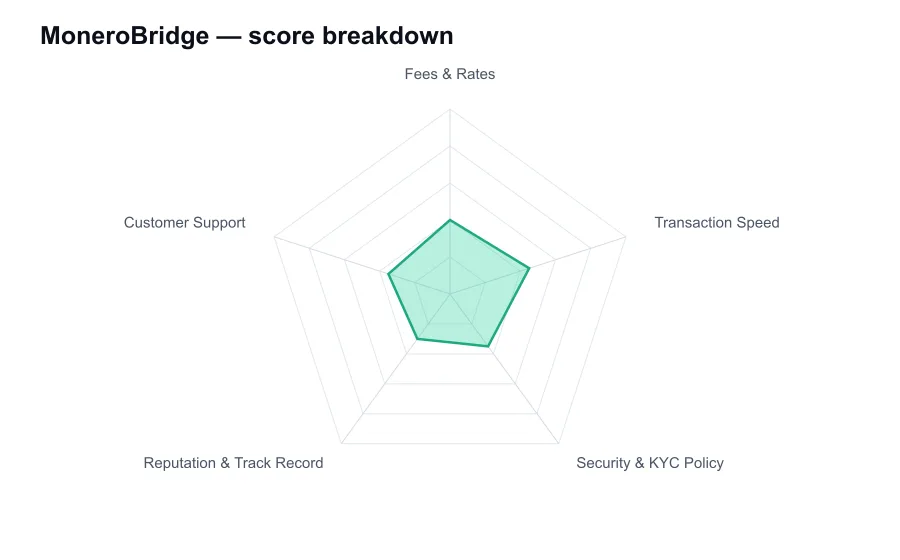
MoneroBridge scores 3.7/10 overall in our independent review, measured against every other provider we've compared, strongest on Transaction Speed (4.5/10) and weakest on Reputation & Track Record (3.0/10).
| Best for | Built around Monero conversion use cases, Simple no-account style flow, Can be useful for a small XMR test swap |
|---|---|
| Not for | Limited verified operating history, Final pricing needs careful comparison, Privacy does not prevent possible compliance checks, Not a strong choice for large or urgent trades |
What is MoneroBridge?
How MoneroBridge Works
- Choose an available pair involving Monero
- Enter the amount and your receiving wallet address
- Review the quoted payout and deposit instructions
- Send the exact asset to the generated address
- Wait for network confirmations and the payout
- Check the completed amount against the original quote
KYC
| Requirement | optional |
|---|---|
| Notes | The flow may not require account registration, but users should assume a transaction can be reviewed and identity documents can be requested. |
Supported Assets
| Notable | Monero |
|---|
How to Use MoneroBridge Safely
- Use a small test amount before a larger XMR conversion
- Check the Monero receiving address before confirming
- Save the deposit transaction ID and order details
- Compare the final payout with competing XMR routes
- Do not send funds needed for an urgent payment
Full Review
MoneroBridge is a crypto conversion service aimed at people who want to move into or out of Monero without opening a conventional exchange account. That niche is real. Monero has been delisted or restricted by several regulated exchanges, so users often turn to instant-swap services. The problem is that this category demands more skepticism than a normal spot exchange, because liquidity, compliance controls, and customer support can all become visible only after funds have been sent.
The service's appeal is obvious. A user generally wants to select a pair, provide a receiving address, and exchange crypto without depositing funds into a long-term custodial account. For privacy-focused Monero users, that is more attractive than sharing personal information with a large centralised platform. It can also be quicker than moving through several exchanges. But convenience should not be confused with low risk.
MoneroBridge does not have the depth of independently verifiable public history that I would expect before routing substantial sums through it. It is not a household name in the way that Kraken, Bitstamp, or Coinbase are, and it does not have a long public record comparable with older instant exchangers such as ChangeNOW or Changelly. That does not automatically disqualify it. It does put the burden on the user to test and verify.
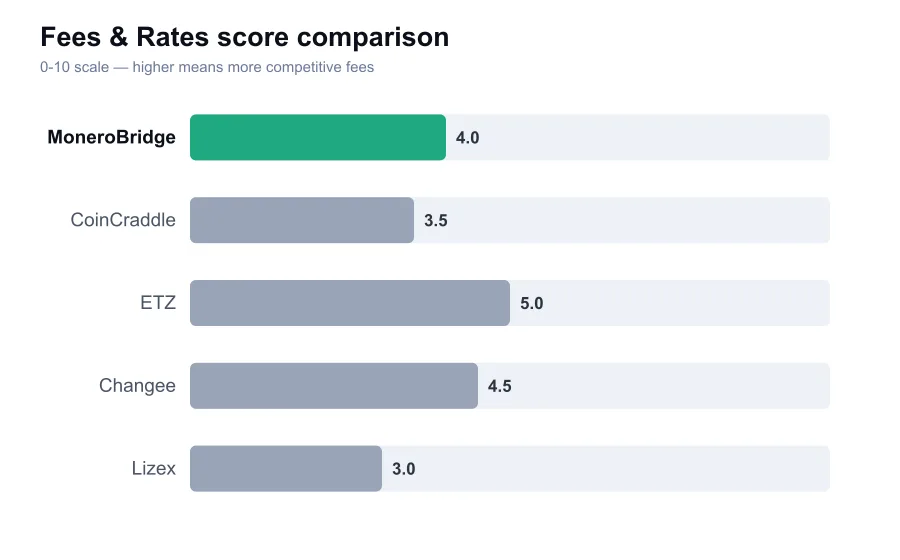
Fees are the first area where instant exchangers can disappoint. The number that matters is not a headline fee, it is the final XMR amount received after the provider's spread, network costs, and liquidity charge. MoneroBridge does not have a broadly documented public fee table that makes independent comparison easy. If its rate appears attractive, compare its final payout against a Monero-capable alternative at the same moment. Monero's market price can move fast enough that comparisons made hours apart are useless.
For modest swaps, a small spread may be a reasonable price for simplicity. For larger conversions, it becomes expensive very quickly. A two percent difference on a 0.1 XMR transaction may not matter much. On a large Bitcoin to Monero conversion, it can cost more than withdrawing from a reputable exchange and using a transparent venue. Users should never assume that no signup means no margin.
Speed depends on both chains. A Bitcoin deposit will require confirmations, and the service then needs to source or release Monero. An Ethereum token transfer can be visible faster, though congestion and token-specific processing can still delay completion. Monero itself has a roughly two-minute block time, but a service may wait for multiple confirmations before treating a deposit as final. There is no strong public body of independently measured MoneroBridge processing data that would justify calling it consistently fast.
That distinction matters if you are trying to time a market move. Instant services can feel immediate until the deposit is flagged, a wallet needs refilling, or the provider's liquidity source is slow. If timing matters, use a venue with an active order book and transparent deposit status. MoneroBridge is better approached as a convenience tool for a small, ordinary conversion, not a reliable execution venue for a time-critical trade.
Privacy is central to the Monero audience, but users should be realistic about what an instant exchanger can promise. Monero's protocol hides certain transaction details on-chain. The service still sees the assets sent to it, the payout address you provide, your connection metadata, and potentially information it requests during compliance checks. A no-account flow is not the same thing as a guarantee that no KYC request will ever happen.
I would assume MoneroBridge can request verification or pause a transfer if its compliance systems flag activity. That is common across this sector, especially where privacy coins are involved. The harsh practical reality is that a user can be attracted by privacy branding, send funds, and then be asked for documents. Before using any service in this category, read its terms, find its stated contact process, and do not use it for funds that cannot tolerate a hold.
Security disclosure is thin. There is no widely cited proof-of-reserves programme, external security audit history, or detailed public explanation of how customer funds are safeguarded between deposit and payout. For an instant exchange, the safest assumption is that the provider controls the assets while the conversion is underway. That is reason enough to avoid large deposits and to use a fresh receiving address under your own control.
Customer support is particularly important for Monero transactions because Monero addresses and payment identifiers can confuse users who are more familiar with Bitcoin or Ethereum. A competent service should offer transaction tracking, clear confirmation requirements, and a support route that can identify an order from its transaction ID. MoneroBridge does not have a widely established public reputation for handling complex support cases, so users should expect less certainty than they would from a large exchange.
There is also a policy risk specific to Monero. Exchanges face changing restrictions around privacy coins, and service availability or payout routes can change. That does not mean every Monero conversion provider is unreliable. It means a user should check the exact pair and network before sending. Never assume that because one XMR route worked last month, every route is available today or will remain available through the whole transaction.
A sensible MoneroBridge test is simple. Use a small amount of a supported asset, send from a wallet that gives you the transaction ID, and receive into a Monero wallet you control. Verify the displayed address carefully because Monero transfers are irreversible. Once the test completes, judge the actual payout against the original quote, the elapsed time, and the quality of any communication. Those are the facts that matter.
My view is that MoneroBridge may appeal to experienced privacy-coin users who understand instant-exchange risk, but it is not a service I would use for a large conversion. The privacy-focused pitch does not remove provider risk. Its limited verifiable reputation, unclear fee transparency, and uncertain support depth keep it well behind better documented alternatives. Treat it as an option to test cautiously, not as a default route for Monero.
Criteria Scores
| Criterion | Score | Note |
|---|---|---|
| Fees & Rates | 4.0 | Compare final XMR payout, not a headline claim. |
| Transaction Speed | 4.5 | Timing depends on confirmations and available liquidity. |
| Security & KYC Policy | 3.5 | No strong public evidence of custody or audit controls. |
| Reputation & Track Record | 3.0 | Limited independently verifiable long-term history. |
| Customer Support | 3.5 | Support quality is not strongly established publicly. |
Key Facts
| Fact | Value | Source |
|---|---|---|
| Core asset | Monero (XMR) | — |
| Monero block time | About 2 minutes | — |
| Fee disclosure | No verified public fixed schedule | — |
| Recommended use | Small test conversions | — |
| Custody risk | Provider controls funds during swap | — |
Pros & Cons
| Pros | Cons |
|---|---|
| Built around Monero conversion use cases | — |
| Simple no-account style flow | — |
| Can be useful for a small XMR test swap | — |
Does MoneroBridge make a swap private?
Monero's protocol provides on-chain privacy, but MoneroBridge can still see your deposit, receiving address, connection data, and any information requested during a compliance review.
Why can a Bitcoin to Monero swap take time?
Bitcoin deposits need blockchain confirmations before processing. Monero itself has an approximate two-minute block time, and the provider may require multiple confirmations.
Can MoneroBridge ask for KYC?
Assume it can. Instant exchangers may request verification when a transaction triggers compliance checks, particularly on privacy-coin related routes.
Should I use MoneroBridge for a large XMR purchase?
I would not. Its independently verifiable reputation and security disclosures are limited. Test a small amount first and use a more documented provider for substantial sums.
What should I compare before sending a Monero swap?
Compare the final XMR payout, expected completion time, confirmation requirements, and network fee against at least two alternatives at the same time.