CoinCraddle
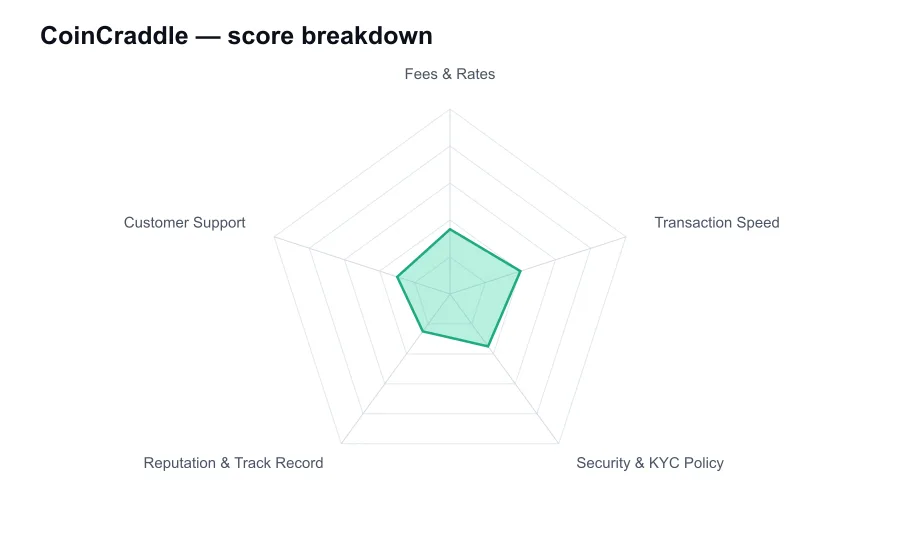
CoinCraddle scores 3.4/10 overall in our independent review, measured against every other provider we've compared, strongest on Transaction Speed (4.0/10) and weakest on Reputation & Track Record (2.5/10).
| Best for | May offer a simple crypto conversion flow, Potentially useful only for a small test swap, Does not require order-book trading knowledge |
|---|---|
| Not for | Very limited public operating record, Fee structure is not independently clear, Unclear support and compliance handling, Not appropriate for meaningful transaction sizes |
What is CoinCraddle?
How CoinCraddle Works
- Confirm the provider and website independently before use
- Select a common asset pair and verify the network
- Review the final payout quote and save the order details
- Send only a trivial test amount to the deposit address
- Wait for confirmations and verify the payout in your own wallet
KYC
| Requirement | tiered |
|---|---|
| Notes | The precise public KYC policy is not sufficiently documented to rely on a no-verification assumption. Any centralized crypto conversion service may review a transaction after deposit. |
How to Use CoinCraddle Safely
- Do not use CoinCraddle for a large first transaction
- Independently verify the domain before entering wallet details
- Compare the exact payout with established exchanges
- Use only a wallet and network you understand
- Save all order records and blockchain transaction hashes
- Avoid deadline-sensitive or undocumented-source funds
Full Review
CoinCraddle is a little-known crypto exchange brand with a public profile far below the established instant-swap services and major centralized exchanges. That fact shapes this review more than any claim on a homepage could. A new or small provider can offer a clean interface and an attractive quote, but crypto users are not merely judging design. They are deciding whether to send irreversible funds to an operator whose ability to execute, support, secure, and return those funds has not been widely tested in public.
I cannot find the kind of durable, independently verifiable operational record that would justify treating CoinCraddle as a peer of ChangeNOW, ChangeHero, Kraken, or Coinbase. There is no well-established body of public reporting, long-running customer feedback, disclosed operational history, or clear evidence of substantial market participation that I would expect before recommending a service for meaningful transfers. That does not prove wrongdoing. It does mean trust has not been earned, and in crypto that distinction is crucial.
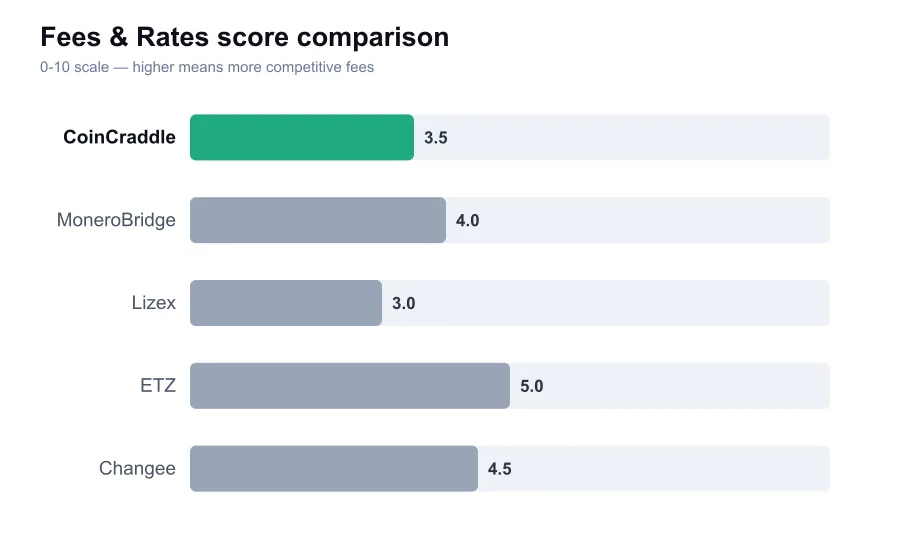
The first concern is pricing transparency. CoinCraddle does not have a widely documented fee schedule that can be reliably compared with the published fee structure of better-known providers. In an instant exchange, the number that matters is never just a percentage shown beside a button. Customers need to know whether the quote incorporates a service charge, a liquidity margin, network costs, and a floating-rate adjustment. If those elements are not clearly documented, a user cannot tell whether a seemingly convenient swap is actually expensive.
For that reason, I would not judge CoinCraddle on a quoted rate alone. Compare the final payout against multiple alternatives at the same time, preferably including one established instant exchanger and one liquid spot exchange. Then ask a harder question: if the provider gives the best quote, why is that? Sometimes it has efficient routing. Sometimes the estimate is optimistic and the final execution is less favorable. With a lightly documented service, the customer has too little historical evidence to know which explanation applies.
Speed claims deserve equal skepticism. Instant exchange services depend on blockchain confirmations, wallet infrastructure, liquidity sources, and internal transaction processing. A simple stablecoin transfer on a fast chain can move quickly. A Bitcoin deposit with a low network fee can take an hour or far longer, and no web interface can change that. What separates a reliable provider is clear status reporting, a documented confirmation policy, and responsive handling when an order falls outside the happy path. CoinCraddle has not supplied enough public evidence for me to score it strongly there.
A customer should never confuse the word instant with guaranteed. The deposit may be received but not yet confirmed. The intended asset may be temporarily unavailable. A market move may affect a floating quote. An address may be incompatible with the chosen network. These are familiar issues, but they become more dangerous with a provider that does not have a deep, visible help center or a long history of resolving public complaints. The smaller the service, the more a user must protect themselves through careful testing.
Security is not simply a question of whether a site uses HTTPS or says it is non-custodial. A transaction-based service may avoid holding a permanent customer balance, yet it still takes possession of the funds during a swap. The user must trust it to perform the exchange, broadcast the payout, and communicate honestly if a compliance system pauses the order. CoinCraddle has not made a sufficiently clear case on public policy, corporate accountability, security controls, or dispute handling for me to consider it a strong choice.
KYC and anti-money-laundering policy are another area where clarity matters. If a service accepts transactions without a conventional account, some users will assume it cannot later request information. That assumption has caused many unpleasant disputes across the instant-swap sector. A provider may decide that a transfer needs review after the money has arrived. CoinCraddle's public documentation is not strong enough for me to state its precise standard process or thresholds with confidence. That alone is a reason not to use it for funds whose source cannot be readily documented.
The reputation picture is the weakest part of the offering. Reputable companies can certainly have complaints. Every provider that handles enough crypto transactions will encounter angry customers after network errors, wrong addresses, and risk checks. What matters is the volume and quality of evidence around how those incidents are addressed. CoinCraddle does not have enough reliable, long-term, independent evidence to demonstrate a consistent record. A few testimonials or directory mentions cannot substitute for years of visible operation.
This is where reviewers should resist the temptation to be polite by inflating a score. Low visibility is not a harmless aesthetic issue. It changes the user's practical recourse. If an established provider delays a payout, there may be an active support team, public social channels, third-party reviews, documented terms, and a larger community that can recognize a recurring issue. With CoinCraddle, those external checks appear limited. The cost of being wrong can be a deposit trapped in a process the user cannot independently audit.
Customer support is similarly hard to score well without public evidence. A contact form or chat icon proves that a page exists. It does not prove that a trained person can explain why a transaction is paused, identify a network mismatch, or process a refund. Before using CoinCraddle, I would inspect the support materials closely and submit a pre-sale question that requires a specific answer about the intended pair and network. If the response is vague, generic, or absent, that is useful information before funds are involved.
There may be a limited case for trying CoinCraddle with a trivial amount. An experienced user who understands wallets, chain selection, transaction hashes, and confirmation delays can make a small test exchange to evaluate the actual flow. The test should use a common asset, a standard network, and an amount the user can afford to have delayed or lost. It should not involve borrowed funds, a payment deadline, an obscure token, or a life-changing sum.
For almost everyone else, there is no compelling reason to choose CoinCraddle ahead of a provider with a stronger public record. Crypto users already accept price volatility and irreversible settlement risk. Adding a poorly documented intermediary does not make a transaction more efficient, it adds another uncertainty. The burden is on CoinCraddle to demonstrate transparent terms, responsive support, real operating history, and independently observable reliability.
My final assessment is intentionally conservative. CoinCraddle may be active as a crypto service, but it does not currently show enough public evidence to earn confidence for normal retail use, much less significant transactions. Its score reflects missing verification, not an accusation that every transaction will fail. Until the company establishes a clearer record, users should choose a larger instant exchanger or a regulated exchange, and anyone determined to test CoinCraddle should treat the first transfer as a disposable experiment.
Criteria Scores
| Criterion | Score | Note |
|---|---|---|
| Fees & Rates | 3.5 | No widely verifiable public fee schedule |
| Transaction Speed | 4.0 | Insufficient public evidence on real-world execution |
| Security & KYC Policy | 3.5 | Security and compliance processes are not well documented |
| Reputation & Track Record | 2.5 | Very limited independently verifiable track record |
| Customer Support | 3.0 | Little public evidence of proven issue resolution |
Key Facts
| Fact | Value | Source |
|---|---|---|
| Service type | Crypto exchange service | — |
| Public track record | Limited independent verification | — |
| Public fee schedule | Not widely verifiable | — |
| Recommended first use | Trivial test amount only | — |
| Review confidence | Low due to limited disclosures | — |
Pros & Cons
| Pros | Cons |
|---|---|
| May offer a simple crypto conversion flow | — |
| Potentially useful only for a small test swap | — |
| Does not require order-book trading knowledge | — |
Is CoinCraddle an established crypto exchange?
CoinCraddle does not have the same long, independently verifiable public track record as established instant exchangers founded in 2017 or earlier. Treat that lack of history as a material risk.
Should I use CoinCraddle for a large swap?
No. Its reputation score here is 2.5 out of 10 because public evidence of durable operation and dispute handling is limited. Use a proven provider for meaningful amounts.
How can I test CoinCraddle safely?
Use a trivial amount, a mainstream asset, and the exact network listed in the order. Save the quote, order ID, deposit address, and transaction hash before sending.
Are CoinCraddle's fees clearly published?
A widely verifiable public fee schedule is not available. Compare the final payout against at least two established services rather than relying on a headline quote.
What happens if a CoinCraddle transaction is delayed?
First check blockchain confirmations and the transaction hash. Because public evidence of support handling is limited, do not use the service for payments that have a strict deadline.